Kronosaurus

Read more about the article Kronosaurus
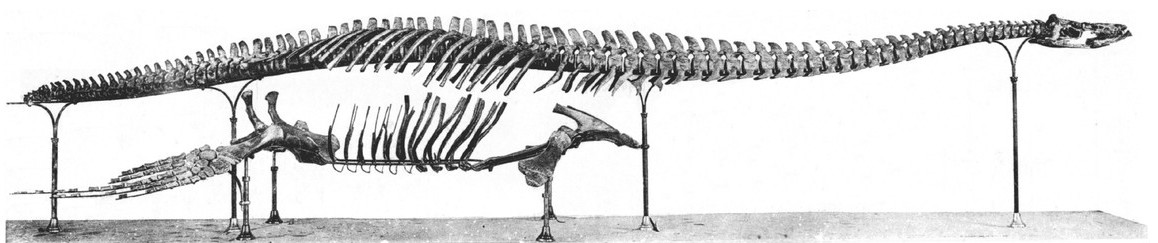
Kronosaurus queenslandicus skeleton in lateral view.

Due to its large size and ferocious appearance, Kronosaurus is one of the most famous plesiosaurs. The iconic skeleton referred to Kronosaurus on display in the Museum of Comparative Zoology in Harvard is nicknamed ‘plasterosaurus’ because so much of it is reconstructed in plaster. About a third of the skeleton is plaster and there are at least seven vertebrae too...

Continue ReadingKronosaurus

Kimmerosaurus

Read more about the article Kimmerosaurus
Skull of Kimmerosaurus. From Brown (1981).

Kimmerosaurus is a poorly known cryptoclidid plesiosaur known only from skull and neck material (Brown 1981, Brown et al. 1986). It differs from other plesiosaurs in the large number of needle-like teeth in its jaws, and in the form of its teeth, which are completely smooth and lack the longitidinal ridges present in other plesiosaurs. Brown et al. (1986) compared...

Continue ReadingKimmerosaurus

Hydrotherosaurus

Read more about the article Hydrotherosaurus
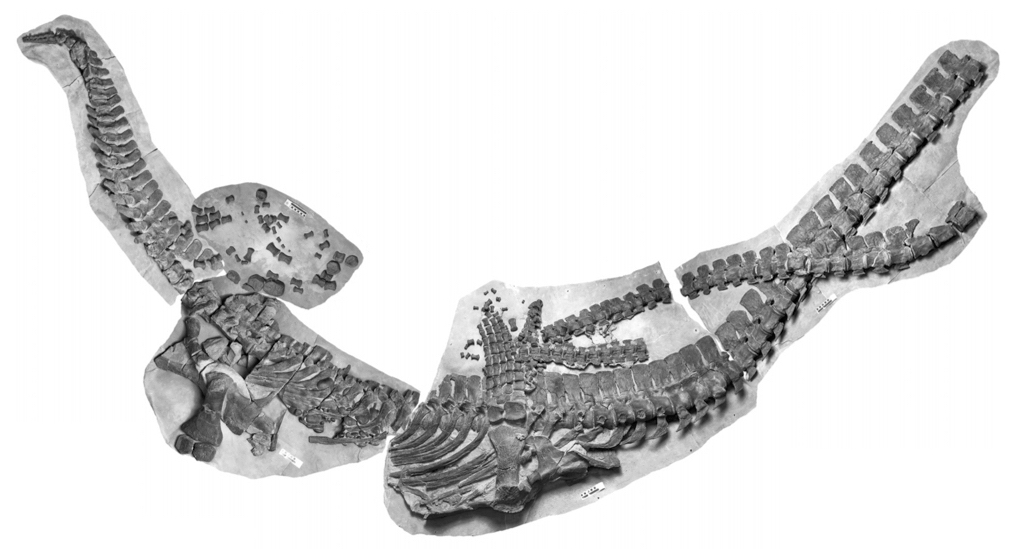
Articulated skeleton of Hydrotherosaurus. From Welles 1943.

Hydrotherosaurus is a long-necked elasmosaurid from California, USA. It is represented by one of the most complete elasmosaurid skeletons ever discovered, so Hydrotherosaurus is one of the best known members of this family. The almost complete type skeleton of Hydrotherosaurus was discovered in the Panoche Hills by Mr. Frank C. Paiva in 1937, and was excavated by the University of...

Continue ReadingHydrotherosaurus

Eretmosaurus

Read more about the article Eretmosaurus
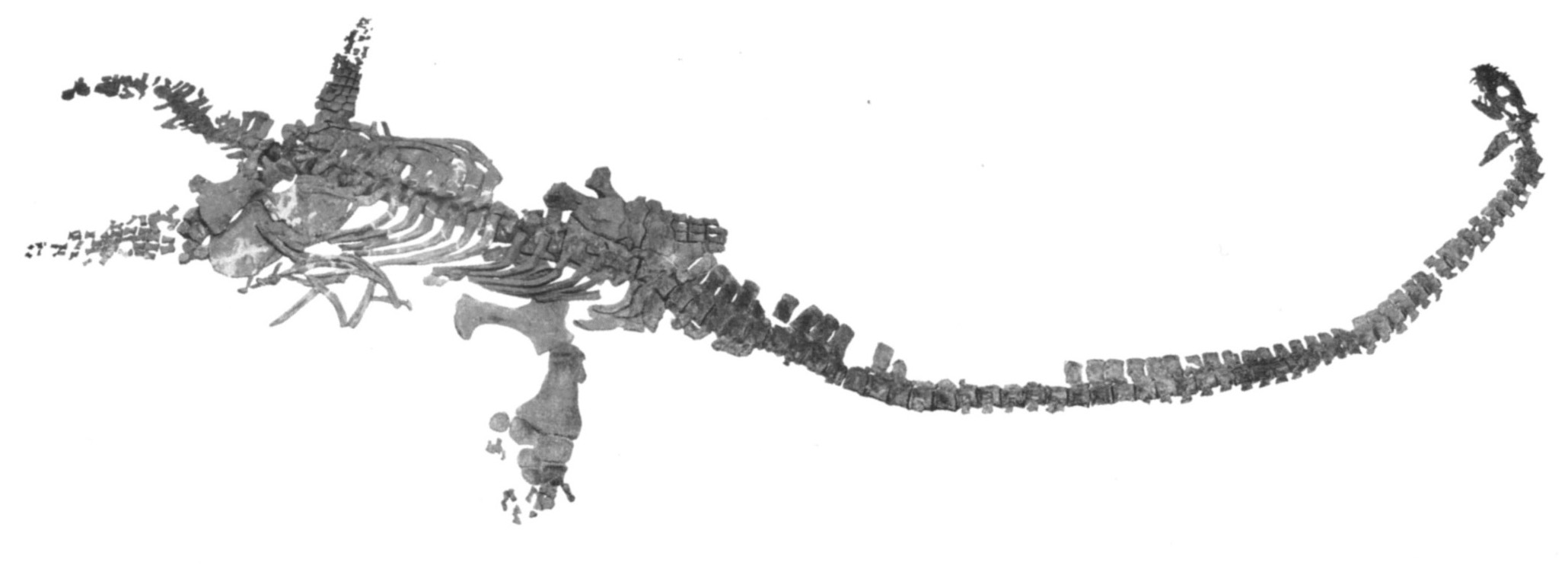
Skeleton of Eretmosaurus. Lithograph from Owen (1865).

The genus Eretmosaurus was erected for ‘Plesiosaurus’ rugosus by Seeley (1874). Eretmosaurus is a rogue taxon in cladistic analyses and researchers have been in disagreement about its taxonomic affinity. Eretmosaurus has been included in several different families: the Rhomaleosauridae based on the anatomy of its girdles (Persson 1963); the Pliosauridae (Brown 1981), the Elasmosauridae (Bardet 1995, Bardet et al. 1999). The...

Continue ReadingEretmosaurus

Elasmosaurus

Read more about the article Elasmosaurus
Skeleton of Elasmosaurus from Cope (1869, revised version)

Elasmosaurus is one of the most widely recognised plesiosaur names and has become a stereotype for all elasmosaurids. However, it is relatively poorly known. The type and only known specimen of Elasmosaurus platyurus (ANSP 10081) includes the tip of the snout, occipital condyle, and the majority of the vertebral column. It is from the Sharon Springs Member (Lower Campanian) of...

Continue ReadingElasmosaurus

Cryptoclidus

Read more about the article Cryptoclidus
Skeleton of Cryptoclidus in lateral view. From Brown (1981).

Cryptoclidus, often wrongly spelled ‘Cryptocleidus’ after Andrews (1909), is a moderately sized plesiosaur with adults about four metres long (Brown 1981). It is known from a large number of individual specimens from the Oxford Clay Formation. Fossils of Cryptoclidus are relatively common, and provide a complete ontogenetic sequence from very young to old adult individuals. This makes Cryptoclidus one of...

Continue ReadingCryptoclidus

Atychodracon

Read more about the article Atychodracon
Holotype specimen of Atychodracon megacephalus in the Bristol City Museum and Art Gallery (from Swinton, 1948). The specimen was destroyed during the Second World War.

The genus Atychodracon was erected by Smith (2015) to accommodate ‘Rhomaleosaurus’ megacephalus, because it is generically separarate from Rhomaleosaurus sensu stricto (Smith and Dyke 2008). A. megacephalus is closely related to Eurycleidus and some authors have regarded A. megacephalus as a distinct species of Eurycleidus. Three dimensional scan with texture (colour) removed of plaster cast (BGS GSM 118410) of the...

Continue ReadingAtychodracon

Attenborosaurus

Read more about the article Attenborosaurus
Photograph of the holotype of Attenborosaurus, before it was destroyed. The skeleton was mounted in a block together with a cast of the opposite side of the body and the opposite side of the head (from Swinton, 1949)

Attenborosaurus is an unusual plesiosaur because it combines a long neck with a relatively large head. It is classified as a pliosaur in some classifications, but some phylogenies place it in a more basal position. The genus was introduced for ‘Plesiosaurus’ conybeari, a species originally described by Sollas (1881). Bob Bakker coined the new genus name to honour the esteemed...

Continue ReadingAttenborosaurus

Aristonectes

Read more about the article Aristonectes
Skull of Aristonectes in various aspects. From Gasparini et al. (2003).

The mysterious plesiosaur Aristonectes is notable for its mouthful of pin-like teeth. A special feeding guild, the ‘trap guild’, has been proposed to accommodate Aristonectes and other plesiosaurs with similar dentition (Chatterjee and Small 1989) such as Cryptoclidus, Kimmerosaurus, and Kaiwhekea. These plesiosaurs may have fed in a similar manner to the extant crabeater seal, using their sieve-like teeth to...

Continue ReadingAristonectes

Apractocleidus

Read more about the article Apractocleidus
Cryptoclidus (the type specimen of 'Apractocleidus', V.1091, with the tail of V.1104 and a replica head) in the Hunterian Museum, Glasgow, Scotland. Photo by Adam S. Smith. 2007.

The genus and species ‘Apractocleidus teretipes‘ was erected by Smellie (1916). Smellie (1915) provided a preliminary account of the specimen before he named it. The specimen is now regarded as an old-adult individual of Cryptoclidus. The taxon ‘Apractocleidus‘ is therefore considered a junior synonym of Cryptoclidus. The specimen was collected by Alfred Leeds and acquired by the Hunterian Museum, Glasgow....

Continue ReadingApractocleidus

Albertonectes

Albertonectes is a very long-necked elasmosaurid from the Late Cretaceous of Alberta, Canada. The holotype specimen (TMP 2007.0110001) consists of an almost complete skeleton lacking a skull (Kubo et al. 2012). The neck contains 76 cervical vertebrae, which is a unique character of Albertonectes vanderveldei and the highest number of neck vertebrae known for any plesiosaur, surpassing the previous record-holder...

Continue ReadingAlbertonectes

Archaeonectrus

Read more about the article Archaeonectrus
Archaeonectrus illustration (From Novozhilov 1964)

The genus Archaeonectrus was proposed by Novozhilov (1964) for ‘Plesiosaurus’ rostratus, a species named by Owen (1865). By modern standards, Owen’s (1865) original description is rather inadequate. One notable characteristic of Archaeonectrus rostratus is the relatively small size of the limbs relative to its body. It has been classified as a pliosauroid, sometimes within the Rhomaleosauridae. Archaeonectrus rostratus is the...

Continue ReadingArchaeonectrus