Bishanopliosaurus

Read more about the article Bishanopliosaurus
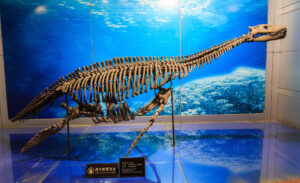
Photo of Bishanopliosaurus on display in the Zigong Dinosaur Museum. Photo by Zhangzhugang. Used here under a CC BY 4.0 licence. The label says it is from "Dashanpu, Zigong", suggesting it isn't the type specimen (from Bishan County, Chongqing), but this could be a mistake.

Bishanopliosaurus is the most complete plesiosaur known from the Jurassic of Asia (Sato et al. 2003). The holotype specimen of the type species, B. youngi, is a partial postcranial skeleton of a juvenile individual from the Dongyuemiao Member of the Ziliujing Formation (Lower or Mid Jurassic) of Bishan County, Chongqing, China. It…

Continue ReadingBishanopliosaurus

Thaumatodracon

Read more about the article Thaumatodracon
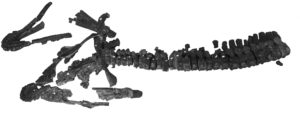
The holotype specimen, laid out in dorsal view.

Thaumatodracon is a relatively large rhomaleosaurid from the Lower Jurassic (Sinemurian) of Lyme Bay – the coast between Lyme Regis and Charmouth – UK. The holotype specimen (NLMH 106.058) is an almost complete skull and cervical (neck) series. It has a 60 cm long skull, and based on comparison with other rhomaleosaurids I…

Continue ReadingThaumatodracon

Avalonnectes

Read more about the article Avalonnectes
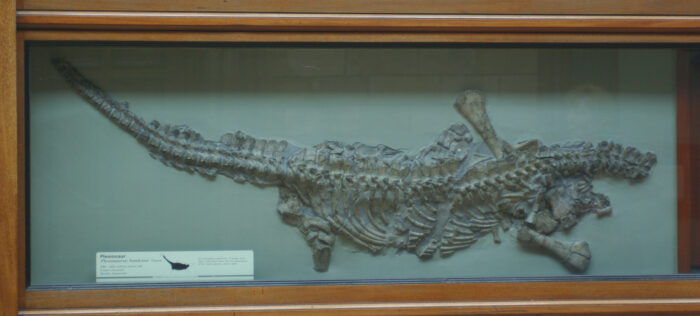
The holotype specimen of Avalonnectes (NHMUK OR 14550), on display in the Natural History Museum, London. Photo by Chris Crump.

Avalonnectes is a small-bodied basal rhomaleosaurid. Avalonnectes was named by Benson, Evans and Druckenmiller (2012) for a partial skeleton including the rear part of the skull from the lowermost Jurassic of Street, Somerset, UK. The specimen (NHMUK PV OR 14550) was previously referred to Thalassiodracon hawkinsii and is one of many historical…

Continue ReadingAvalonnectes

Rhomaleosauridae

Read more about the article Rhomaleosauridae
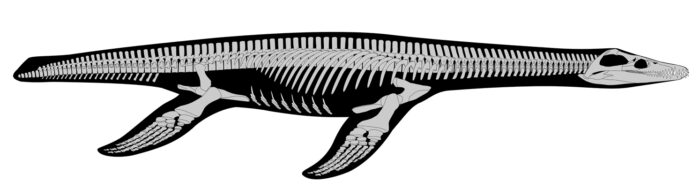
Reconstruction of Rhomaleosaurus thorntoni. From Smith and Benson (2014).

Cast of the holotype of Rhomaleosaurus cramptoni. Taken in the Natural History Museum, London (photograph by Hector E. Rivera). All rhomaleosaurids have a relatively large head with a moderately long neck composed of about 28 vertebrae. The group has a stratigraphic range from the Lower Jurassic to the Middle Jurassic. The Rhomaleosauridae…

Continue ReadingRhomaleosauridae

Rhomaleosaurus

Read more about the article Rhomaleosaurus
Reconstruction of Rhomaleosaurus thorntoni. From Smith and Benson (2014).

Rhomaleosaurus is the largest known Lower Jurassic pliosaur and was the top predator in early Jurassic marine ecosystems. It has a reinforced skull to help resist torsion and a ferocious set of teeth, a combination of characters perfect for snatching and killing cephalopods, fish, and other marine reptiles. Historically, the genus Rhomaleosaurus…

Continue ReadingRhomaleosaurus

Meyerasaurus

Read more about the article Meyerasaurus
The holotype specimen of Meyerasaurus (SMNS 12478) from the Posidonia-Schiefer, Holzmaden, Germany.

M. victor was originally described and figured by Fraas (1910). Historically, M. victor has been regarded as a species of Rhomaleosaurus and is often associated in the literature under the defunct name 'Thaumatosaurus'. See my article about this history of 'Thaumatosaurus' here. Smith and Vincent (2010) identified M. victor as generically distinct from…

Continue ReadingMeyerasaurus

Macroplata

Macroplata is a rhomaleosaurid plesiosaur from the Lower Jurassic of Warwickshire, UK. Macroplata was named and briefly described by Swinton (1930a) based on a single skeleton from Harbury, Warwickshire, and the skeleton was redescribed in detail by Ketchum and Smith (2010). Photograph of Macroplata tenuiceps in situ in Harbury, Warwickshire. White (1940)…

Continue ReadingMacroplata

Atychodracon

Read more about the article Atychodracon
Holotype specimen of Atychodracon megacephalus in the Bristol City Museum and Art Gallery (from Swinton, 1948). The specimen was destroyed during the Second World War.

The genus Atychodracon was erected by Smith (2015) to accommodate 'Rhomaleosaurus' megacephalus, because it is generically separarate from Rhomaleosaurus sensu stricto (Smith and Dyke 2008). A. megacephalus is closely related to Eurycleidus and some authors have regarded A. megacephalus as a distinct species of Eurycleidus. Three dimensional scan with texture (colour) removed…

Continue ReadingAtychodracon

Archaeonectrus

Read more about the article Archaeonectrus
Archaeonectrus illustration (From Novozhilov 1964)

The genus Archaeonectrus was proposed by Novozhilov (1964) for 'Plesiosaurus' rostratus, a species named by Owen (1865). By modern standards, Owen's (1865) original description is rather inadequate. One notable characteristic of Archaeonectrus rostratus is the relatively small size of the limbs relative to its body. It has been classified as a pliosauroid,…

Continue ReadingArchaeonectrus

Dublin plesiosaur on the move

South Dublin City, 6.30am, Thursday 10th of August 2006. I clamber into the passenger seat of a 4x4 - destination London. My travelling companions are Colin in the driver's seat, and two suspiciously large wooden crates. A monster lurks inside: the skull of the Dublin plesiosaur. The plan is to transport the…

Continue ReadingDublin plesiosaur on the move

The Collard Plesiosaur

Press reports of the finding of a plesiosaur on the Somerset coast hit the news last year. Dennis Parsons of Somerset County Museum has given presentation on this remarkable specimen at the SPPC, and during our 'Plesiosaur Day' in November 2004. Arthur Cruickshank, Mark Evans and I (Richard Forrest) have visited the…

Continue ReadingThe Collard Plesiosaur