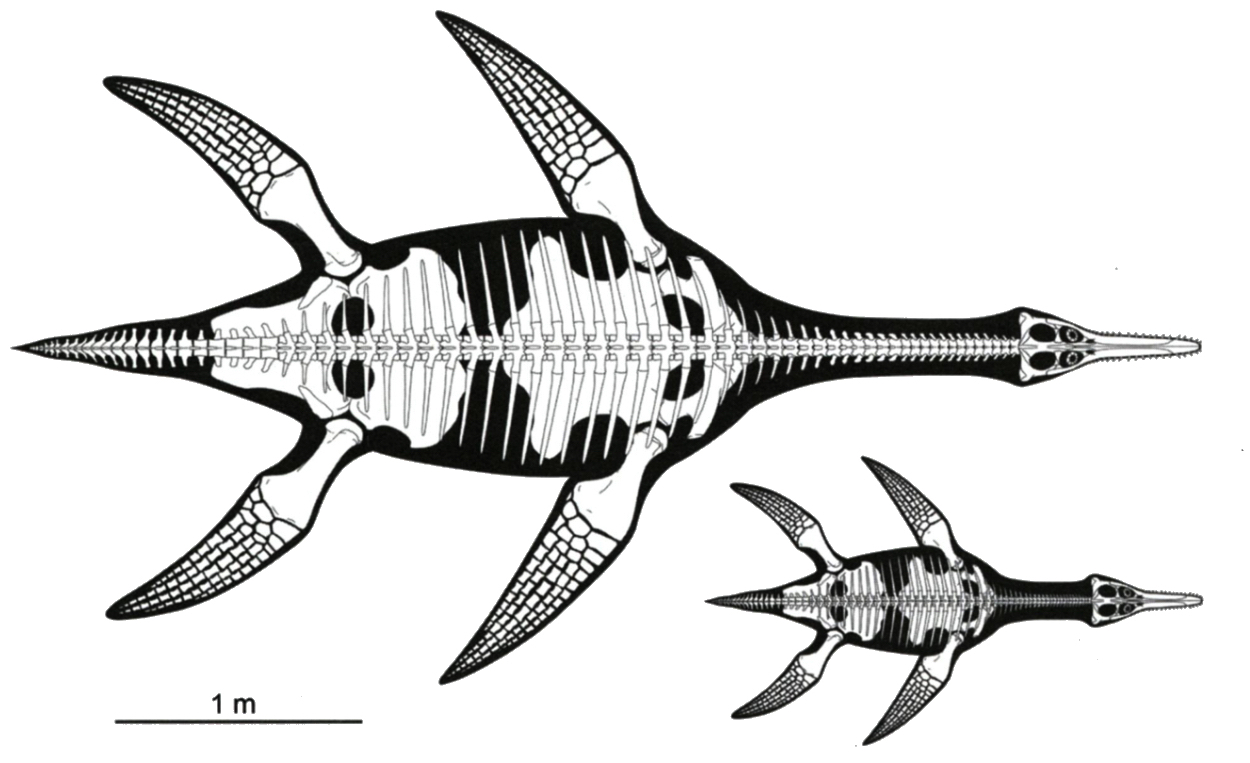
Opallionectes is a large, around 5 m long, derived cryptoclidid plesiosauroid from the Early Cretaceous of South Australia. It is known from a partial opalised skeleton, which is mounted for display in the South Australian Museum. The holotype specimen lacks a skull.
Category «Genus page»
Plesionectes
Umoonasaurus
Umoonasaurus is a small (~2.5 m long) leptocleidid that lived during the Early Cretaceous in Southern Australia. The holotype specimen (AM F99374), a spectacular opalised skeleton including the skull, is nicknamed ‘Eric’. It is the most complete opalised plesiosaur skeleton (and fossil vertebrate) known.
Eardasaurus
Alexeyisaurus
Alexeyisaurus is the stratigraphically oldest named possible plesiosaur. It was named and described by Sennikov and Arkhangelsky (2010) as an elasmosaurid plesiosaur from the Late Triassic of Franz Josef Land, Russia. This would be highly unusual because the oldest definitive elasmosaurid plesiosaurs are otherwise restricted to the Cretaceous Period.
Polycotylus
Polycotylus latipinnis was the first short-necked plesiosaur to be recognised in North America (Carpenter 1996), and the first polycotylid to be described and named (Cope 1869). It was established in the same volume that coined the name Elasmosaurus and contained the infamous ‘head on the wrong end’ reconstruction (Cope 1869).