Leptocleidus

Read more about the article Leptocleidus
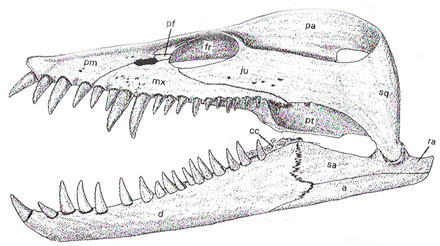
Skull of Leptocleidus capensis in lateral view (from Cruickshank, 1997)

Lower Cretaceous plesiosaurs are rare, so Leptocleidus is important because it fills a gap in the fossil record of plesiosaurians. Leptocleidus was once considered to be a late surviving member of the family Rhomaleosauridae but it has recently been reidentified as a close relative of polycotylids. The fossils of all known species…

Continue ReadingLeptocleidus

Hydrotherosaurus

Read more about the article Hydrotherosaurus
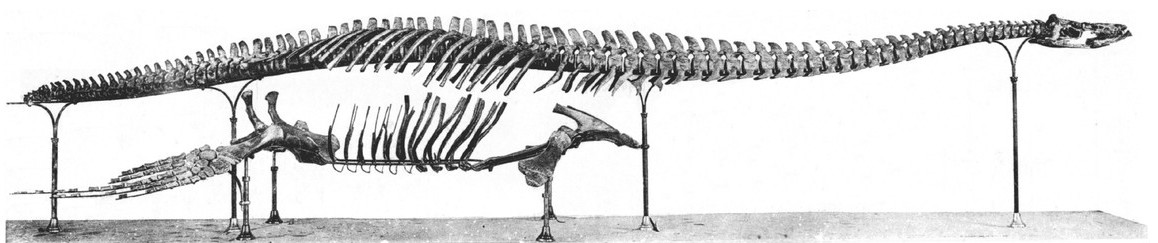
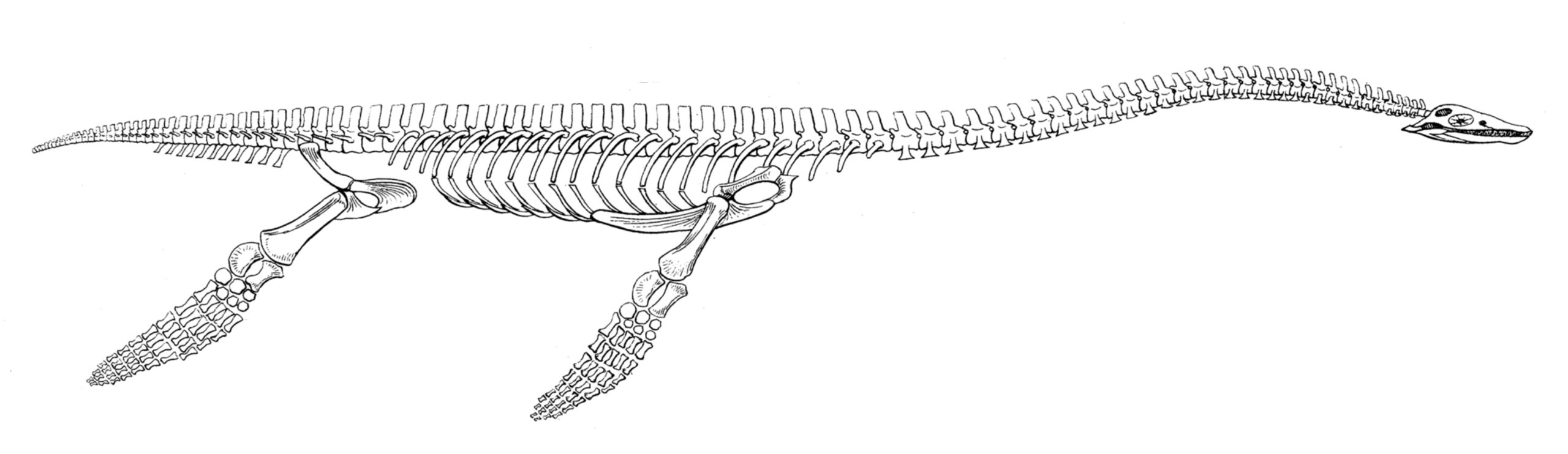
Articulated skeleton of Hydrotherosaurus. From Welles 1943.

Hydrotherosaurus is a long-necked elasmosaurid from California, USA. It is represented by one of the most complete elasmosaurid skeletons ever discovered, so Hydrotherosaurus is one of the best known members of this family. The almost complete type skeleton of Hydrotherosaurus was discovered in the Panoche Hills by Mr. Frank C. Paiva in…

Continue ReadingHydrotherosaurus

Elasmosaurus

Read more about the article Elasmosaurus
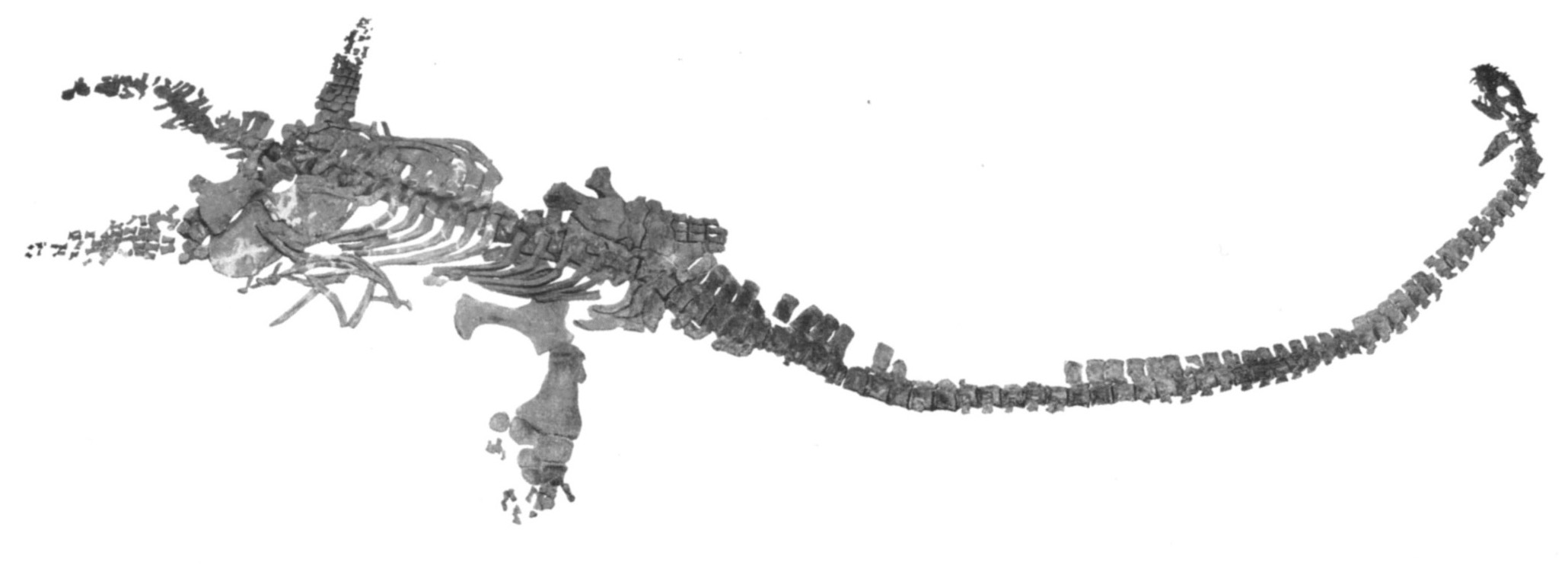
Skeleton of Elasmosaurus from Cope (1869, revised version)

Elasmosaurus is one of the most widely recognised plesiosaur names and has become a stereotype for all elasmosaurids. However, it is relatively poorly known. The type and only known specimen of Elasmosaurus platyurus (ANSP 10081) includes the tip of the snout, occipital condyle, and the majority of the vertebral column. It is…

Continue ReadingElasmosaurus

Cryptoclidus

Read more about the article Cryptoclidus
Skeleton of Cryptoclidus in lateral view. From Brown (1981).

Cryptoclidus, often wrongly spelled 'Cryptocleidus' after Andrews (1909), is a moderately sized plesiosaur with adults about four metres long (Brown 1981). It is known from a large number of individual specimens from the Oxford Clay Formation. Fossils of Cryptoclidus are relatively common, and provide a complete ontogenetic sequence from very young to…

Continue ReadingCryptoclidus

Aristonectes

Read more about the article Aristonectes
Skull of Aristonectes in various aspects. From Gasparini et al. (2003).

The mysterious plesiosaur Aristonectes is notable for its mouthful of pin-like teeth. A special feeding guild, the 'trap guild', has been proposed to accommodate Aristonectes and other plesiosaurs with similar dentition (Chatterjee and Small 1989) such as Cryptoclidus, Kimmerosaurus, and Kaiwhekea. These plesiosaurs may have fed in a similar manner to the…

Continue ReadingAristonectes

Apractocleidus

Read more about the article Apractocleidus
Cryptoclidus (the type specimen of 'Apractocleidus', V.1091, with the tail of V.1104 and a replica head) in the Hunterian Museum, Glasgow, Scotland. Photo by Adam S. Smith. 2007.

The genus and species 'Apractocleidus teretipes' was erected by Smellie (1916). Smellie (1915) provided a preliminary account of the specimen before he named it. The specimen is now regarded as an old-adult individual of Cryptoclidus. The taxon 'Apractocleidus' is therefore considered a junior synonym of Cryptoclidus. The specimen was collected by Alfred…

Continue ReadingApractocleidus

Albertonectes

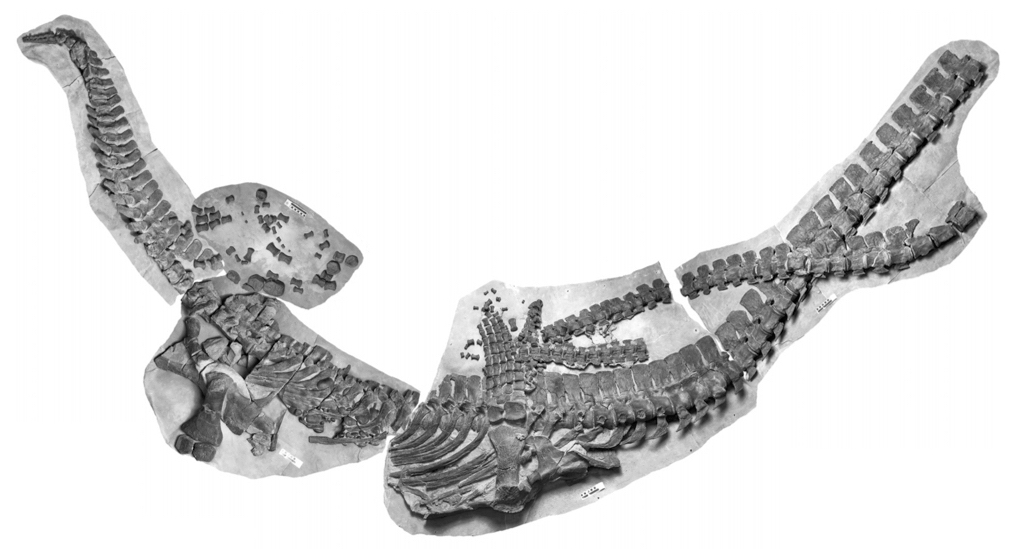
Albertonectes is a very long-necked elasmosaurid from the Late Cretaceous of Alberta, Canada. The holotype specimen (TMP 2007.0110001) consists of an almost complete skeleton lacking a skull (Kubo et al. 2012). The neck contains 76 cervical vertebrae, which is a unique character of Albertonectes vanderveldei and the highest number of neck vertebrae…

Continue ReadingAlbertonectes

Why did elasmosaurids have such a long neck?

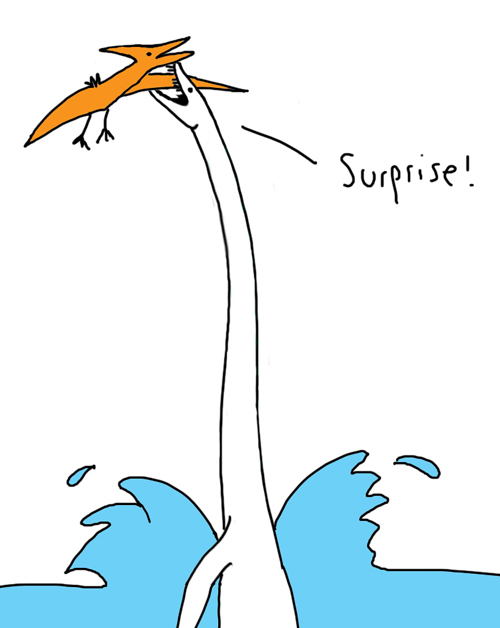
It was once common knowledge that elasmosaurid plesiosaurs were bendy-necked beasts that swanned about near the surface, striking snake-like at slippery prey. It is now common knowledge that their necks were relatively rigid rod-like structures, the function of which remains something of a mystery. The truth, with regard to flexibility at least,…

Continue ReadingWhy did elasmosaurids have such a long neck?

Book review: Plesiosaur Peril by Daniel Loxton

In Plesiosaur Peril, author Daniel Loxton plunges us into the Jurassic ocean, to recount a day in the life of a baby Cryptoclidus. The book is the third in Loxton's 'Tales of Prehistoric Life' series, which includes the stories Ankylosaur Attack and Pterosaur Troubles. In this short children's story we follow a juvenile Cryptoclidus…

Continue ReadingBook review: Plesiosaur Peril by Daniel Loxton

Prepared ‘Kreis Hoxter plesiosaur’ is new taxon

I previously reported (see here and here) on the plesiosauroid skeleton discovered in 2007 in Kreis Hoxter, near Bielefeld, Northern Germany. The specimen was excavated from the Pliensbachian (Lower Jurassic) age strata in ten large blocks by the LWL-Museum für Naturkunde, Münsterand. A major proportion of the fossil has now been prepared by…

Continue ReadingPrepared ‘Kreis Hoxter plesiosaur’ is new taxon

The name game: Plesiosaur-ia, -oidea, -idae, or -us?

Read more about the article The name game: Plesiosaur-ia, -oidea, -idae, or -us?
Reconstruction of Plesiosaurus dolichodeirus in lateral view. From Conybeare (1824).

Proper taxonomic names, with formal suffixes, can be confusing at the best of times. But when they include identical prefixes their meaning can be further complicated. For example, to what taxonomic group does the colloquial term 'plesiosaur' refer: Plesiosauria, Plesiosauroidea, Plesiosauridae, or Plesiosaurus? With all these similar sounding names it is not surprising that laypersons and specialists…

Continue ReadingThe name game: Plesiosaur-ia, -oidea, -idae, or -us?

Update on the ‘Kreis Hoxter plesiosaur’

I reported in Summer 2007 on a four-metre-long plesiosaur skeleton that was discovered in Kreis Hoxter, near Bielefeld, Northern Germany by amateur collector Sönke Simonsen. I can now provide a short update on the fossil. The specimen was successfully excavated in ten large blocks by the LWL-Museum für Naturkunde, Münsterand, where preparation…

Continue ReadingUpdate on the ‘Kreis Hoxter plesiosaur’