
Muraenosaurus
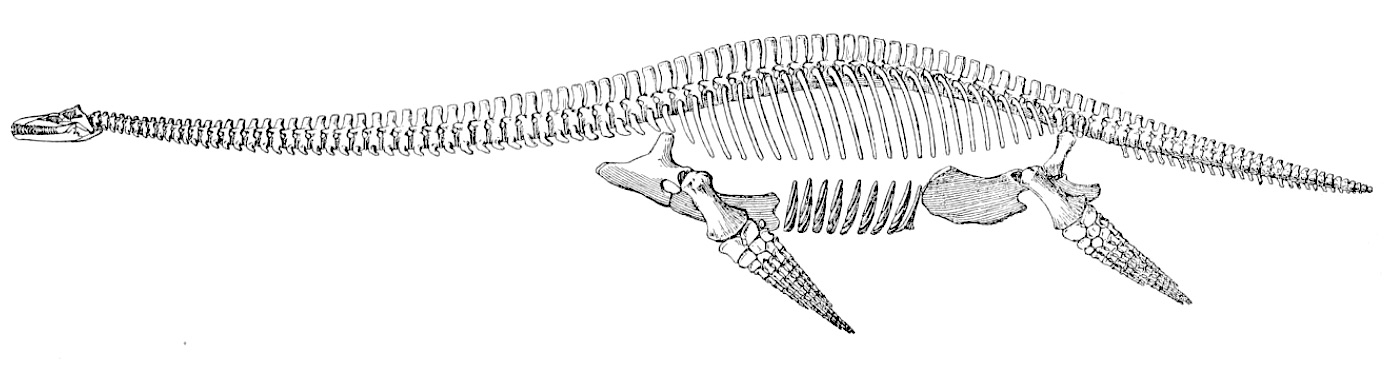
Brown (1981) diagnosed Muraenosaurus as follows: “Plesiosauroids in which the teeth are ornamented with many longitudinal ridges; the dentary bears 19 to 22 teeth on each ramus; the premaxillae bear 5 teeth each, of which the 1st and 5th are small, and the 2nd to 4th are large; the most anterior maxilliary tooth (6th upper tooth) is small and the...
Lusonectes
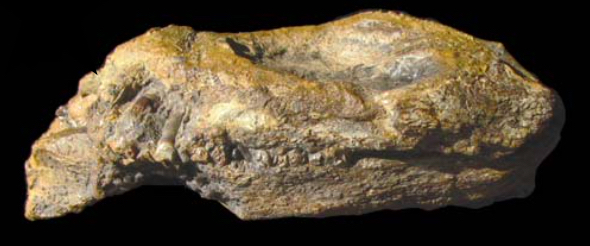
Lusonectes is a poorly known microcleidid the Toarcian (Lower Jurassic) of Portugal. It is known from a single holotype specimen (MG33), a partial skull in the Museu Geológico, Lisbon, Portugal. It was described and named by Smith et al. (2012) as the first diagnostic plesiosaur species from Portugal, and the westernmost occurrence of a plesiosaur in Europe. The genus name...
Microcleidus

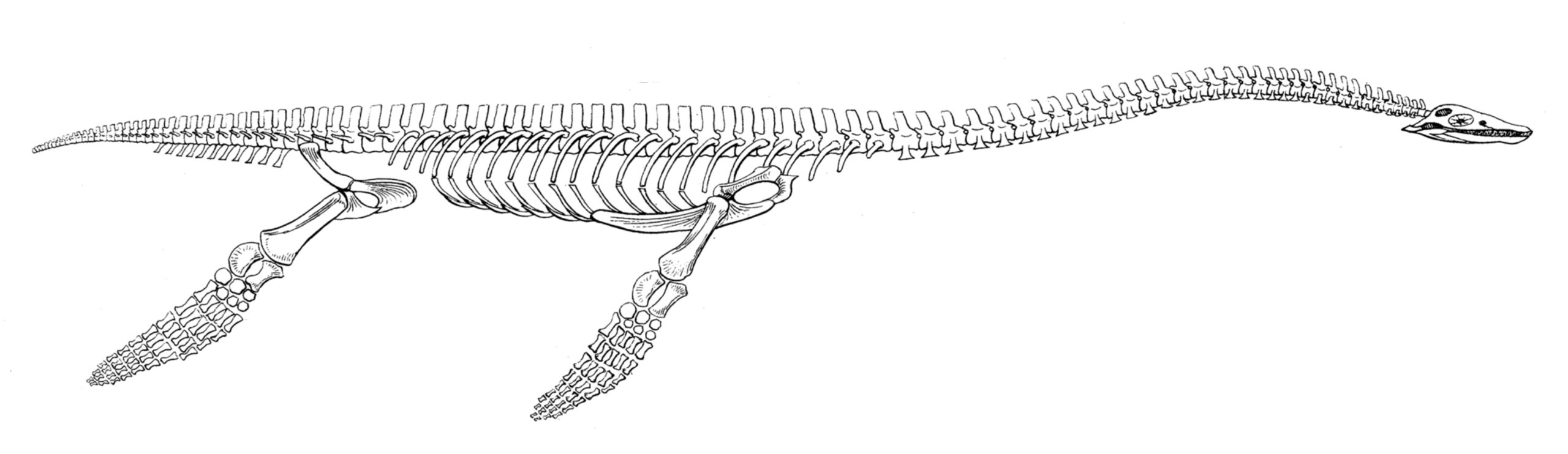
Microcleidus is a medium (4.27 m) to large (5.03 m) plesiosauroid with a small head and a long neck containing 38–39 cervical vertebrae. Watson (1909) erected Microcleidus to accommodate fossil material belonging to ‘P.’ homalospondylus and ‘P.’ macropterus (Watson 1911). Both species were considered valid by Seeley (1865), Blake (1876) and Watson (1911) on the basis of slight differences in the limbs,...

Westphaliasaurus
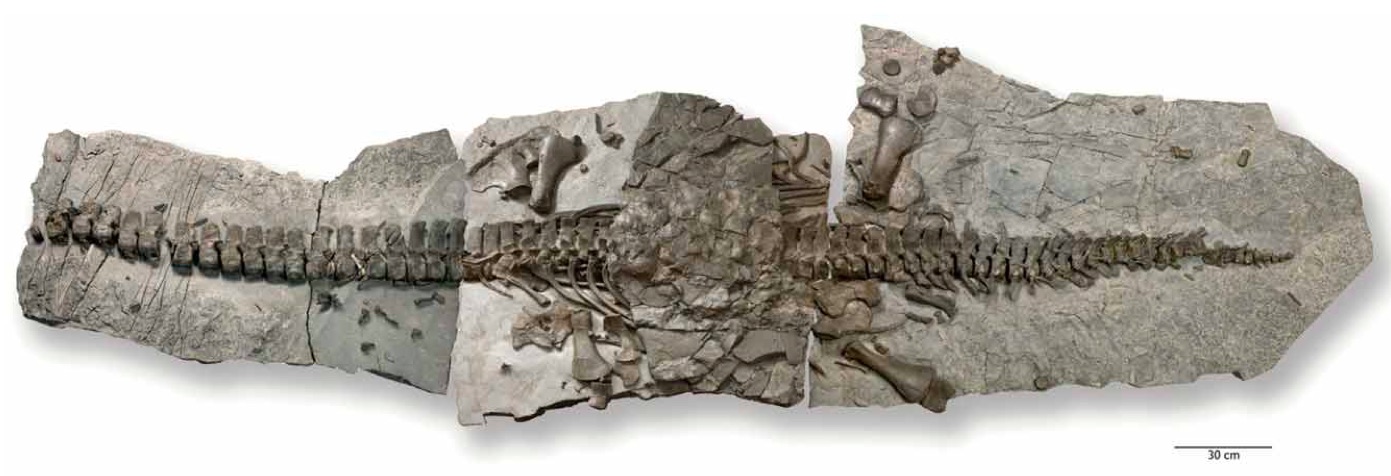
Under construction Skeleton of Westphaliasaurus. The central slab of the skeleton was awaiting preparation at the time of this photograph, but was subsequently prepared. From Schwermann & Sander (2011)....
Styxosaurus
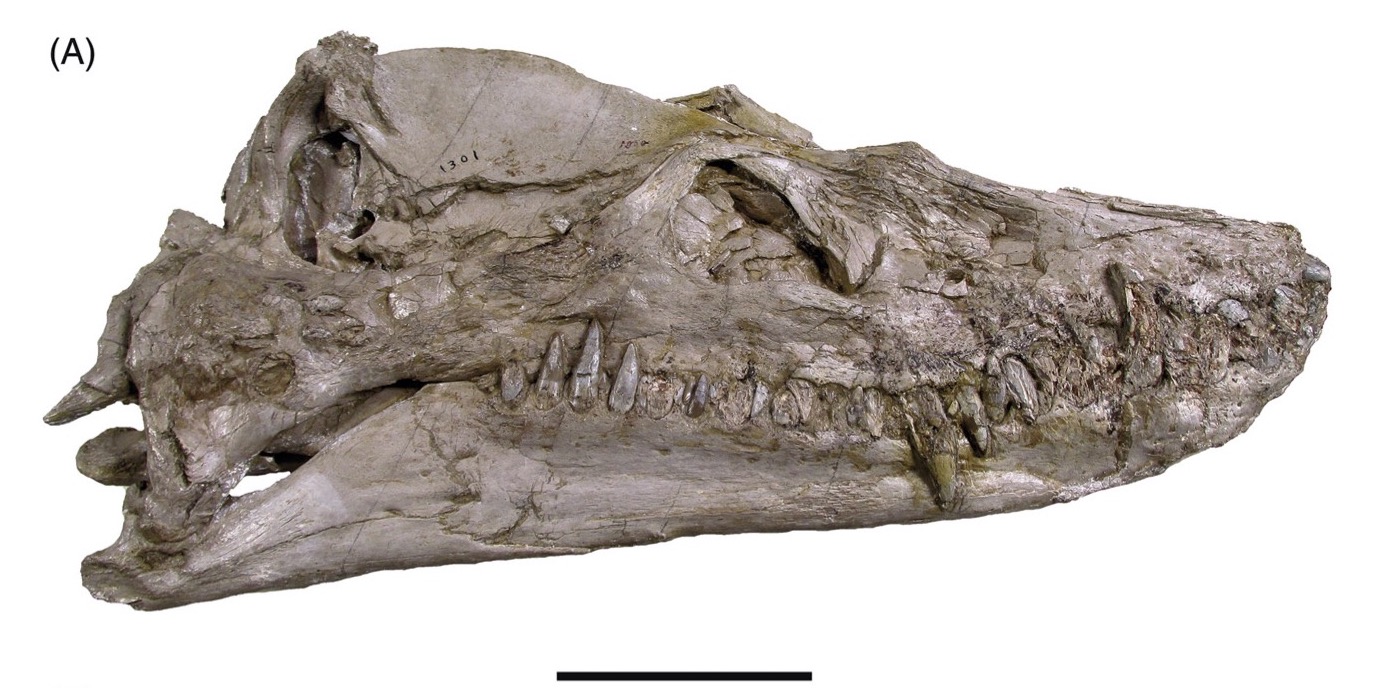
The holotype specimen (KUVP 1301) of Styxosaurus is an articulated skull and anterior portion of the neck. It was found in the Niobrara Chalk near Hell Creek, Logan County, Western Kansas in 1890. It was described later that year as a new species Cimoliosaurus snowii by Williston (1890a) (and in more detail soon after by Williston 1890b), who subsequently...
Ogmodirus

The type skeleton of ‘Ogmodirus’ was collected in 1909 by C. Boyce from the upper Greenhorn Limestone Formation (Lower Turonian, Upper Cretaceous) of Cloud County (near Aurora), Kansas (Storrs 1999, Schumacher and Everhart 2005). The specimen, KUVP 441, is a partial skeleton consisting of partial vertebral column (51 cervical vertebrae, 18 caudal vertebrae), limb, and girdle elements. Originally named...
Plesiosauroidea
The superfamily Plesiosauroidea is one of the two major traditional divisions of plesiosaurs, the group that typically have long necks. Cryptoclidus in the Hunterian Museum, Glasgow, Scotland. Photo by Adam S. Smith. 2007. The other major group (superfamily) of plesiosaurs is the Pliosauroidea (often just called pliosaurs). During the 1990s and 2000s, this simple division of plesiosaurs into two superfamilies...
Tricleidus

Tricleidus is a cryptoclidid from the Oxford Clay Formation of the UK. The holotype specimen (NHMUK R 3539) consists of disarticulated elements including most of skull and half the postcranium, from the Kosmoceras jasoni – Peltoceras athleta zones from the lowest deposits of the Oxford Clay Formation. The type and only species of Tricleidus is T. seeleyi. Persson (1962) erected...
Thililua

Thililua has 30 cervical vertebrae. Each cervical has a longitudinal ridge on its lateral surfaces, this is a convergent feature with elasmosaurids. The skull of Thililua is relatively large with a short postorbital region and elongate rostrum. The type specimen (MHNGr.PA.11710) consists of a complete skull, entire cervical and pectoral series, and the first four dorsal vertebrae. Skull and neck...
Thalassomedon

The holotype of Thalassomedon was discovered by R. L. Landberg in 1939 in Baca County, Colorado. Thalassomedon has a short and deep atlas-axis and 62 cervical vertebrae, and there is no pectoral or pelvic bar in the adult condition (Carpenter 1999). The species name haningtoni is sometimes wrongly spelled ‘hanningtoni’ (as in Carpenter 1999) or ‘haringtoni’ (as in the AMNH...
Plesiosaurus
Plesiosaurus was the first plesiosaur discovered and named (De la Beche and Conybeare 1821). The first 1821 description was based on partial remains so the anatomy of Plesiosaurus – particularly the identity of the isolated bones and how they articulated together – involved some guesswork. An attempted reconstruction of the forelimb of Plesiosaurus by De la Beche and Conybeare (1821)....
Occitanosaurus

‘Occitanosaurus’ was described by Sciau et al. (1990) and Bardet et al. (1999). The genus name was erected for ‘Plesiosaurus’ tournemirensis by Bardet et al. (1999). The taxon was originally regarded as an early elasmosaurid but is now considered a member of the Microcleididae. ‘Occitanosaurus’ was approximately 3.9 meters long. The type material (MMM J. T. 86-100), in the Musée...