
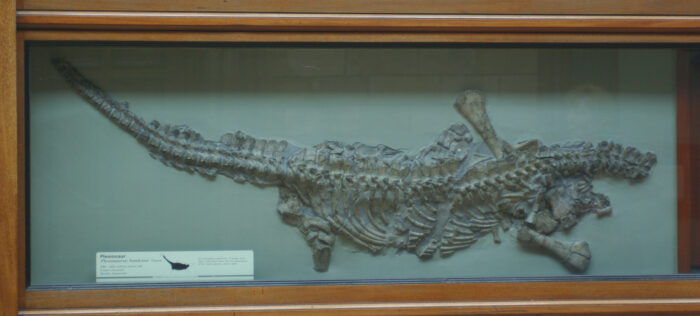
Avalonnectes is a small-bodied basal rhomaleosaurid. Avalonnectes was named by Benson, Evans and Druckenmiller (2012) for a partial skeleton including the rear part of the skull from the lowermost Jurassic of Street, Somerset, UK. The specimen (NHMUK PV OR 14550) was previously referred to Thalassiodracon hawkinsii and is one of many historical plesiosaur skeletons preserved on slabs on display in the Natural History Museum, London.
Category «Plesiosauria»
Eurycleidus
Under construction
‘Ogmodirus’
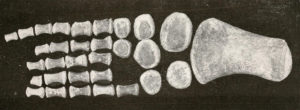
The type skeleton of ‘Ogmodirus’ was collected in 1909 by C. Boyce from the upper Greenhorn Limestone Formation (Lower Turonian, Late Cretaceous) of Cloud County (near Aurora), Kansas (Storrs 1999, Schumacher and Everhart 2005). The specimen, KUVP 441, is a partial skeleton consisting of partial vertebral column (51 cervical vertebrae, 18 caudal vertebrae), limb, and girdle elements.
Maresaurus
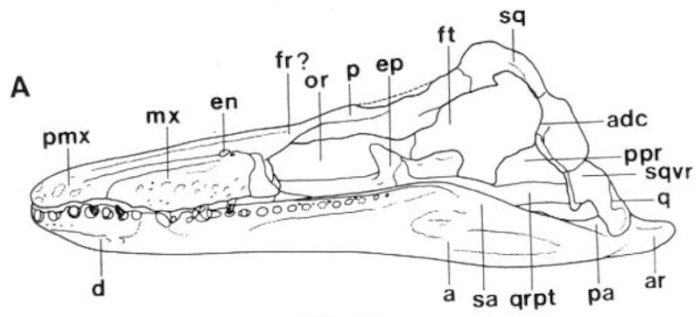
M. coccai (Gasparini 1997) type material: MOZ 4386 V articulated skull and mandible, atlas-axis and first cervical vertebrae. From the upper part of the Los Molles Formation, Cuyo Group, Emileia giebeli and Emileia multiformis subzone.
Skull of Maresaurus in lateral, dorsal and ventral view.
Tricleidus
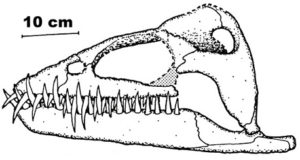
Tricleidus is a cryptoclidid from the Oxford Clay Formation of the UK. The holotype specimen (NHMUK R 3539) consists of disarticulated elements including most of skull and half the postcranium, from the Kosmoceras jasoni – Peltoceras athleta zones from the lowest deposits of the Oxford Clay Formation.
Thililua
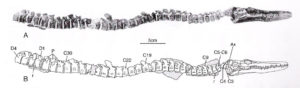
Thililua has 30 cervical vertebrae. Each cervical has a longitudinal ridge on its lateral surfaces, this is a convergent feature with elasmosaurids. The skull of Thililua is relatively large with a short postorbital region and elongate rostrum.
Thalassomedon

The holotype of Thalassomedon was discovered by R. L. Landberg in 1939 in Baca County, Colorado. Thalassomedon has a short and deep atlas-axis and 62 cervical vertebrae, and there is no pectoral or pelvic bar in the adult condition (Carpenter 1999).
Thalassiodracon
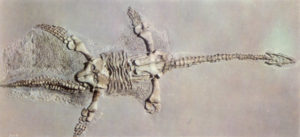
The species Plesiosaurus hawkinsii was introduced in 1838 for a small plesiosaurian from Street, Somerset. The new genus name Thalassiodracon was erected decades later following an examination of a referred skull in Cambridge (CAMSM J.46986). Thalassiodracon means ‘Sea Dragon’, which “alludes to the colloquial description given to the Street marine reptile fauna by Hawkins” (Storrs and Taylor 1996, p.404).