
Liopleurodon is a pliosaur that hardly needs introduction since appearing as the villain in the BBC’s ‘Walking with Dinosaurs’ TV series. This led to popular misconceptions about the size of Liopleurodon, which is known to have reached adult sizes in the region of seven metres long, nowhere near the gargantuan 25m estimate proposed by the series and later perpetuated elsewhere.
The holotype specimen is a single tooth (BHN 3R 197) from Boulogne-sur-Mer, Le Wast, northern France. It was described and figured in 1873 by Sauvage (1873). The institutional abbreviation BHN stands for Musée d´Histoire Naturelle, Boulogne-sur-Mer, France, where the specimen was originally housed, but the specimen is now housed in the Musée d’histoire naturelle de Lille (Lille Natural History Museum), France (Vincent et al. 2024).
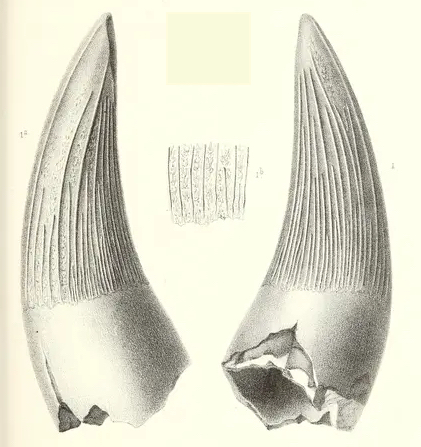
The tooth morphology is still broadly regarded as diagnostic and on this basis many other specimens have been referred to Liopleurodon (Madzia et al. 2022), especially from England. However, there is some variability in the tooth morphology of specimens referred to Liopleurodon, and Madzia et al. (2022) have suggested “It may therefore be needed that an ICZN petition is filed to replace BHN 3R 197, the type of L. ferox, with a different specimen, for example NHMUK PV R 3536 that is reasonably complete and has been commonly treated in comparative studies as a ‘typical’ representative of L. ferox.”
Liopleurodon differs from Pliosaurus in the following characters: relatively short mandibular symphysis with 5-7 teeth adjacent to it), each lower jaw ramus contains 25-28 teeth, the teeth have fewer longitudinal ridges on outer (labial) surface relative to the inner (lingual) surface, and relatively longer epipodial bones in the limbs. According to the classification of Tarlo (1960), the teeth of Callovian species of Liopleorodon (L. ferox) are circular in cross section, whereas they are trihedral (triangular in cross section) in later Kimmeridgian species (L. rossicus, L. macromerus). A similar trend occurs in the closely related genus Pliosaurus. However, revision of Jurassic pliosaurid taxonomy is underway and the relationships of Jurassic pliosaurus are still poorly understood. The species macromerus, previosuly included by some authors in Pliosaurus and by others in Liopleurodon, may turn out to be a distict genus.
L. ferox is the most common species of Liopleurodon from the Oxford Clay, but then a lot of isolated material is referred to it by default. According to Tarlo (1960), L. pachydeirus differs from L. ferox in the morphology of its teeth and cervical vertebrae. The teeth of L. pachydeirus have enamel ridges closely packed on the inner surface and 6-7 evenly spaced ridges on the outer surface, and the cervical vertebrae have a faint ventral keel (Tarlo 1960).


Also, Liopleurodon was in no way magical, Charlie.