CAMSM J.63919
A partial postcranial skeleton. One of two syntype skeletons of Colymbosaurus megadeirus. The other is CAMSM J.29596etc....

A partial postcranial skeleton. One of two syntype skeletons of Colymbosaurus megadeirus. The other is CAMSM J.29596etc....
A partial postcranial skeleton with elements numbered CAMSM J.29596–29691 and J.59736–59743 (shortened in the literature to just “CAMSM J.29596etc). One of two syntype skeletons of Colymbosaurus megadeirus, the other being CAMSM J.63919....

Tricleidus is a cryptoclidid from the Oxford Clay Formation of the UK. The holotype specimen (NHMUK R 3539) consists of disarticulated elements including most of skull and half the postcranium, from the Kosmoceras jasoni – Peltoceras athleta zones from the lowest deposits of the Oxford Clay Formation. The type and only species of Tricleidus is T. seeleyi. Persson (1962) erected...
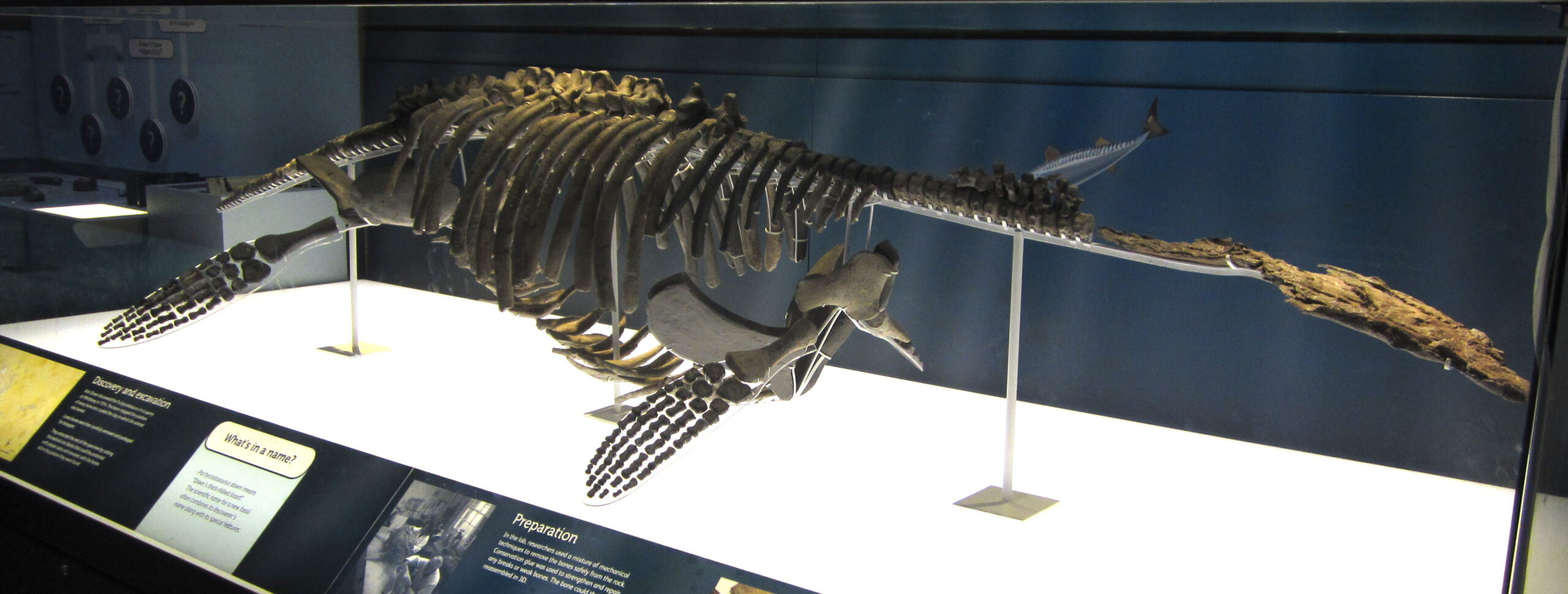
Pachycostasaurus is approximately 3.1 meters long. Its rib cage and vertebrae exhibit thickened bone (Cruickshank et al. 1996) a condition termed pachyostosis. This heavy ossification is unusual in plesiosaurs (another exception may include Kronosaurus), although it is common in basal sauropterygians, especially pachypleurosaurs. Pachycostasaurus probably used the extra ballast provided by its heavy bones to traverse the sea bed searching...

The genus and species ‘Apractocleidus teretipes‘ was erected by Smellie (1916). Smellie (1915) provided a preliminary account of the specimen before he named it. The specimen is now regarded as an old-adult individual of Cryptoclidus. The taxon ‘Apractocleidus‘ is therefore considered a junior synonym of Cryptoclidus. The specimen was collected by Alfred Leeds and acquired by the Hunterian Museum, Glasgow....