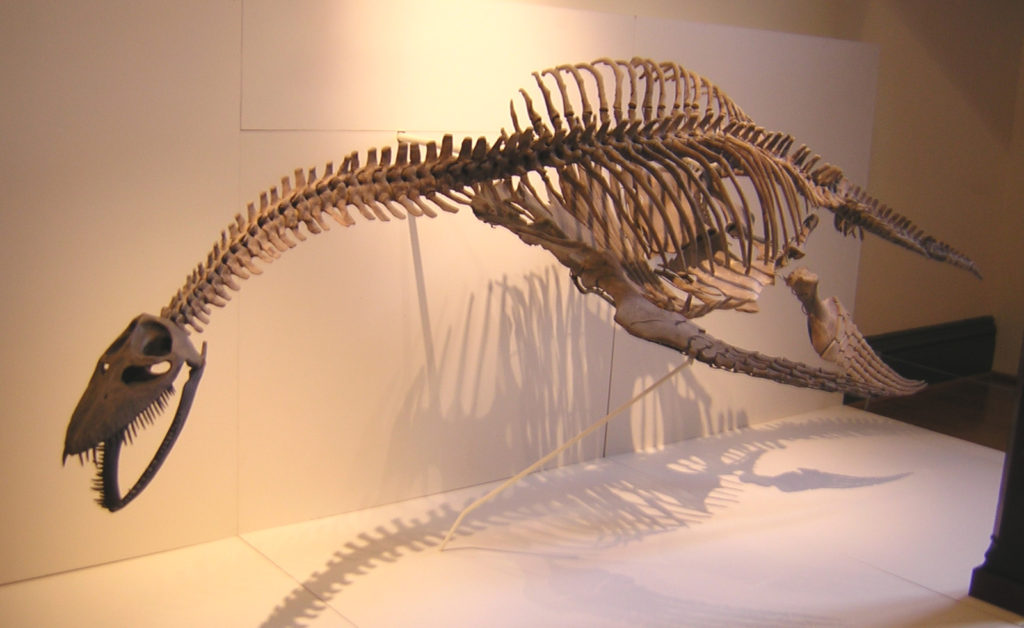

The genus and species ‘Apractocleidus teretipes‘ was erected by Smellie (1916). Smellie (1915) provided a preliminary account of the specimen before he named it. The specimen is now regarded as an old-adult individual of Cryptoclidus. The taxon ‘Apractocleidus‘ is therefore considered a junior synonym of Cryptoclidus. The specimen was collected by Alfred Leeds and acquired by the Hunterian Museum, Glasgow.
Smellie (1916) diagnosed Apractocleidus as follows: “Plesiosaurs in which the neck is composed of about twenty-nine vertebras, of which the centra are wider than high and slightly higher than long. The oval articular ends are concave in the centre but convex near the margin. There are three pectoral vertebrae and twenty-three dorsals, or two pectorals and twenty-four dorsals. The shoulder-girdle is of Elasmosaurian type, and so ossified as to form a very rigid structure. The coracoids are exceptionally broad, and the postero-lateral processes are greatly produced. The dorsal rami of the scapulae are widely extended in a similar fashion. The ventral ramus of the scapula is large, and in the adult the anterior portion has grown forward beyond the clavicles, which are very thin films of bone lying wholly within the visceral surface of the scapulae. A rudimentary interclavicle may be present. In the mid-ventral line the scapulae and the anterior parts of the coracoids impart a slightly carinate appearance to the shoulder-girdle. The humerus is greatly expanded distally, and articulates with four elements. The pelvis is of great breadth, and the wide spread of the antero-external angles of the pubes, taken in conjunction with the breadth of the shoulder-girdle, indicates a genus of exceptionally broad build. The femur is slightly smaller and more slender than the humerus, and is not greatly expanded distally.”
The holotype and only specimen is mounted on display in the Hunterian Museum, Glasgow. In 2011 it was conserved, moved, and remounted by Nigel Larkin.