Thaumatodracon – the Wonder Dragon

Read more about the article <i>Thaumatodracon</i> – the Wonder Dragon
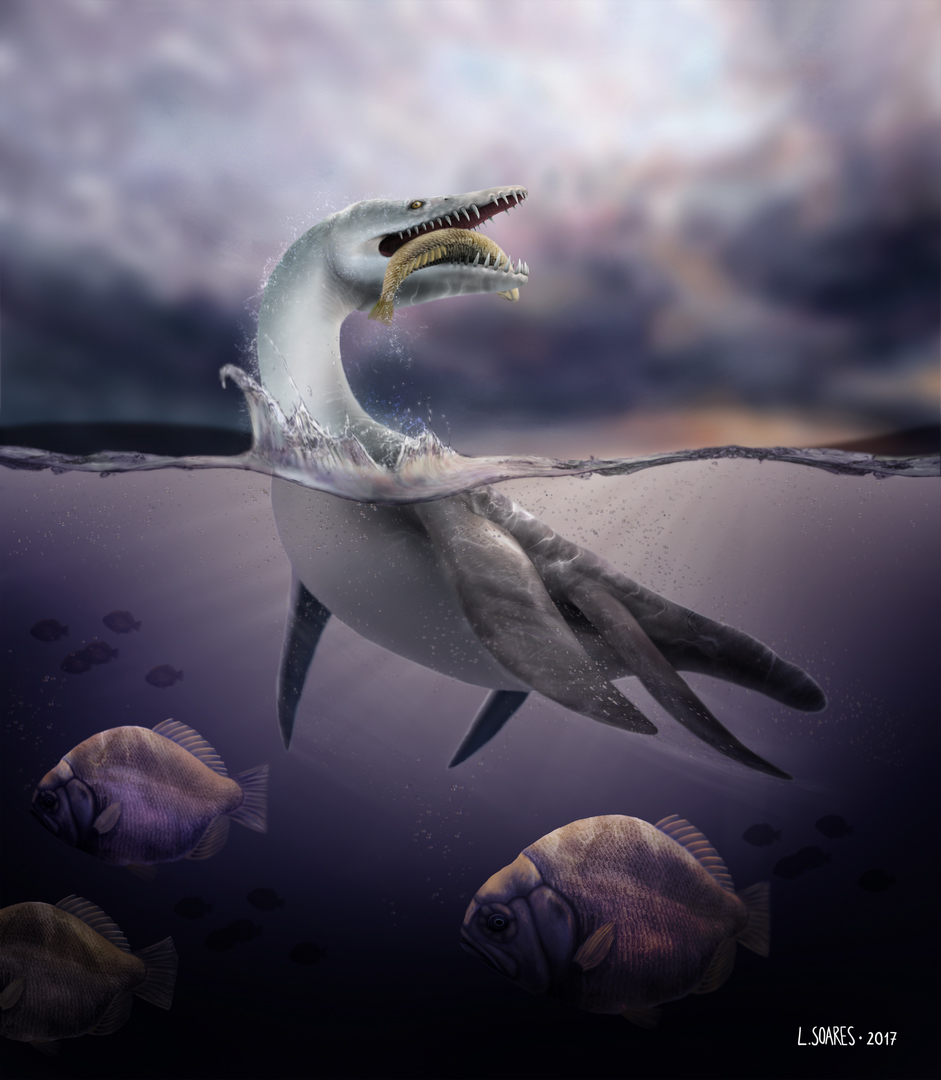
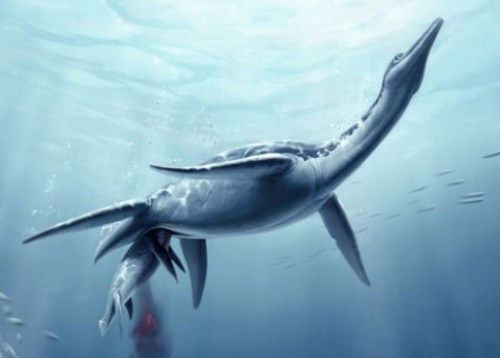
The Lower Saxony State Museum commissioned artist Luzia Soares to create a stylistic impression of Thaumatodracon. Copyright L. Soares 2017

In 2012 I co-presented a poster at the SVP annual meeting on a new plesiosaur from Lyme Regis, UK (see my article about it here). The long awaited follow up paper was finally published this summer in the latest volume of Palaeontographica A (Smith and Araújo 2017) and the beast now has…

Continue ReadingThaumatodracon – the Wonder Dragon

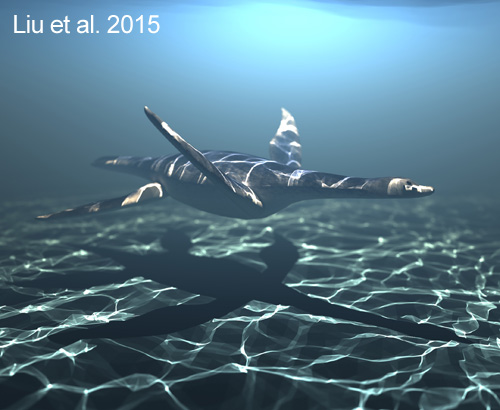
Investigating plesiosaur swimming using computer simulations

One of the many areas of controversy in plesiosaur palaeobiology is the topic of how they swam. The question goes back almost 200 years to the 1820s when the first complete plesiosaurs were described from the Jurassic cliffs of Lyme Regis, UK. Plesiosaur swimming is a particularly difficult topic to study for…

Continue ReadingInvestigating plesiosaur swimming using computer simulations

Resurrecting the Unfortunate Dragon

Read more about the article Resurrecting the Unfortunate Dragon
Holotype specimen of Atychodracon megacephalus in the Bristol City Museum and Art Gallery (from Swinton, 1948). The specimen was destroyed during the Second World War.

The five metre-long holotype specimen of ‘Plesiosaurus’ megacephalus, from the Jurassic of Street-on-the-Fosse, Somerset, was one of several plesiosaurs once displayed in the Bristol Museum and Art Gallery. As one of the earliest plesiosaurs to evolve it is an important species for understanding the early history of the group. Sadly, the fossil…

Continue ReadingResurrecting the Unfortunate Dragon

Monograph on Rhomaleosaurus thorntoni

Read more about the article Monograph on <i>Rhomaleosaurus thorntoni</i>
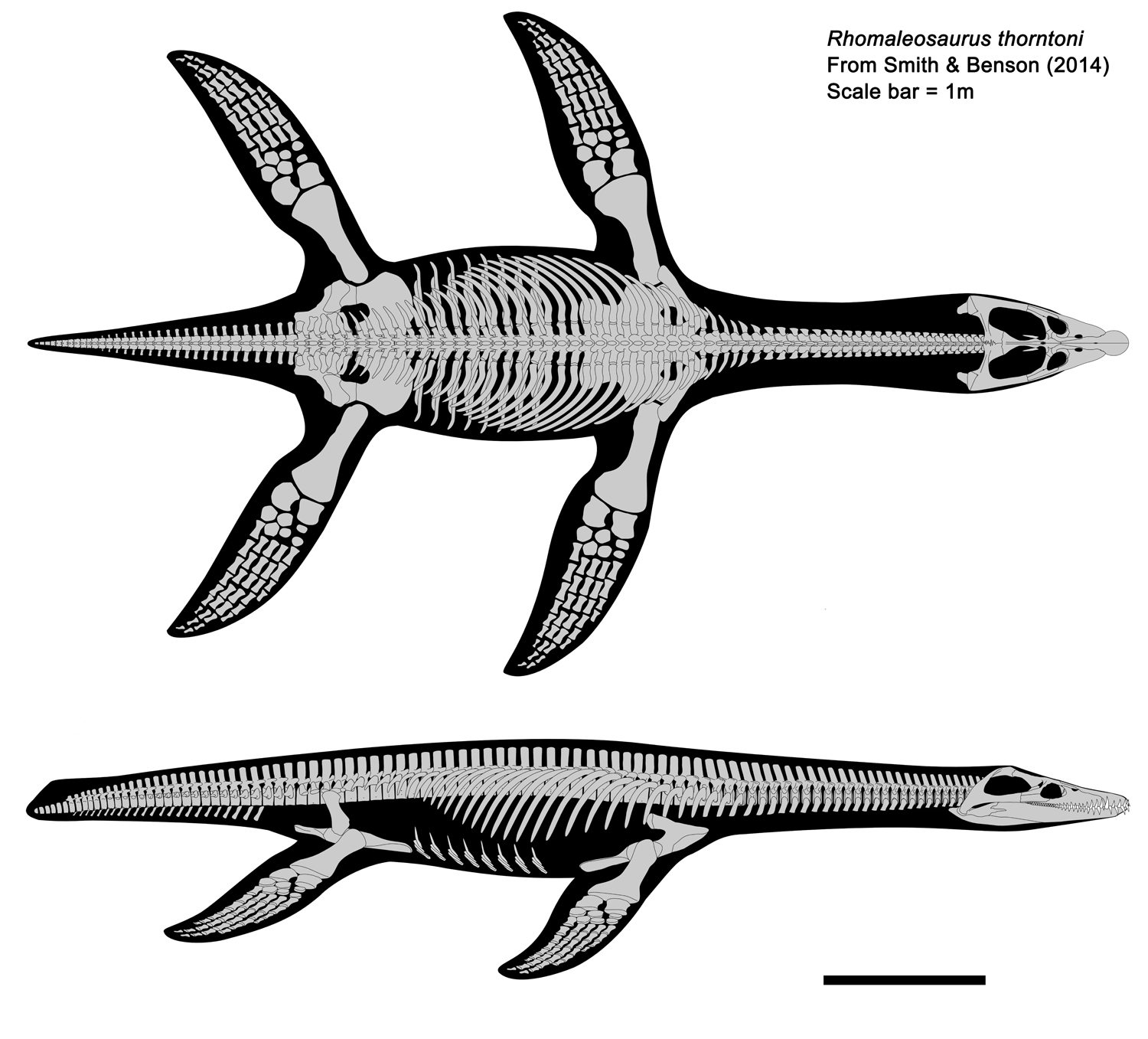
Reconstruction of the skeleton of Rhomaleosaurus thorntoni from Smith & Benson (2014).

Many readers will be familiar with the giant plesiosaur on display in the marine reptiles gallery of the Natural History Museum, London. This is a cast of the 7 metre long holotype of Rhomaleosaurus cramptoni, the original of which is housed in the National Museum of Ireland (Natural History) and formed the…

Continue ReadingMonograph on Rhomaleosaurus thorntoni

Pliosaurus kevani – the Weymouth Bay Pliosaur

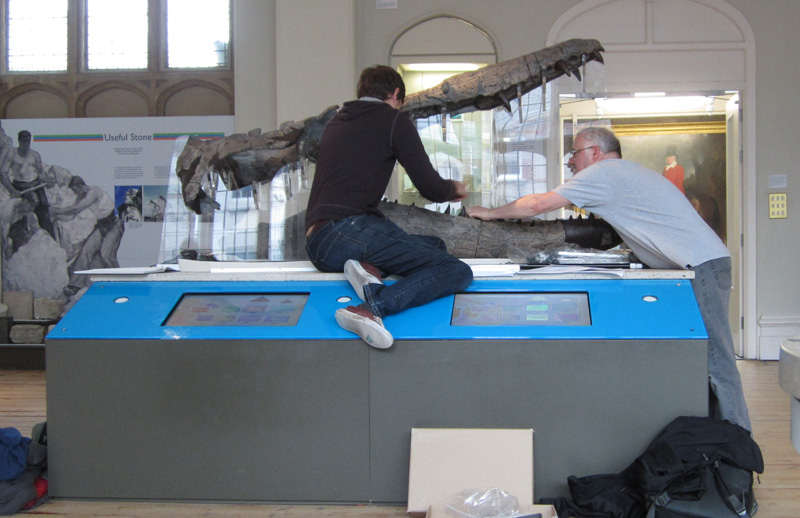
I've been rather quiet again recently, however, as coauthor of an article just published in PLOS ONE, I've good reason to come out of my shell today. The new paper describes and names the Weymouth Bay Pliosaur, a spectacular almost complete skull over 2m long. As discussed in the open access paper…

Continue ReadingPliosaurus kevani – the Weymouth Bay Pliosaur

New plesiosaurs, lots of new plesiosaurs!

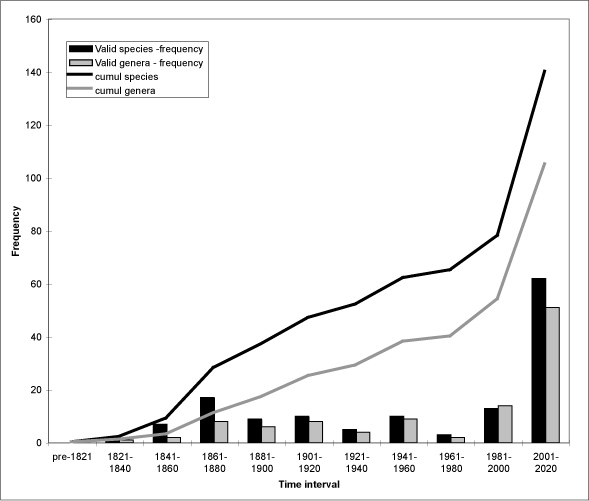
There was a time when I'd leap into tippy-tappy action at the first sniff of a newly named plesiosaur. Unfortunately, I haven't been keeping Plesiosaur Bites up to date and a few new taxa have passed me by. Of course, when I say "a few", what I really mean is we are…

Continue ReadingNew plesiosaurs, lots of new plesiosaurs!

An old debate settled – plesiosaurs gave birth to live young

Read more about the article An old debate settled – plesiosaurs gave birth to live young
Depiction of Polycotylus giving birth to a single large baby. Based on evidence presented by O'Keefe and Chiappe 2011. Image by S. Abramowicz/NHM

An exciting new paper published this week in the journal Science (Vol. 333, p.870-873) provides the first direct evidence for live birth in plesiosaurs, and may have implications for plesiosaur behaviour (O'Keefe and Chiappe 2011). The plesiosaur Polycotylus giving birth to a single large baby. Based on new fossil evidence. Image by…

Continue ReadingAn old debate settled – plesiosaurs gave birth to live young

Recent plesiosaur papers – a round up

So far, 2008 has seen a healthy number of new papers on plesiosaurs and a few new taxa too. Way back in February, Druckenmiller and Russell (2008a) introduced Nichollsia borealis, a plesiosaur of uncertain affinity, based on a beautifully preserved specimen from Alberta, Canada. More recently, Druckenmiller and Russell (2008b) published a…

Continue ReadingRecent plesiosaur papers – a round up

Hydrorion – a new plesiosaur from Germany

The most recent issue of the ‘Palaeontology’ (Vol 49, Part 3) features an article by Franziska Grossman on the plesiosauroids from the Jurassic Posidonia Shale in Germany. Grossman describes the skulls of two genera, Seeleyosaurus guilelmiimperatoris (a tongue-twister of a taxon! - formerly Plesiosaurus guilelmiimperatoris) and introduces a new genus Hydrorion brachypterygius…

Continue ReadingHydrorion – a new plesiosaur from Germany

Two new species of polycotylid plesiosaurs

The second paper in the two-part report on by Albright et al. on plesiosaurs from the Upper Cretaceous Tropic Shale of southern Utah (Journal of Vertebrate Palaeontology, Volume 27(1) p. 41-58), introduces two new genera and species of polycotylid plesiosaur and contributes to the systematics of polycotylid plesiosaurs. The first new genus…

Continue ReadingTwo new species of polycotylid plesiosaurs

Two new plesiosaur species and new data on Brachauchenius

The most recent Journal of Vertebrate Palaeontology (Volume 27(1)) contains three new plesiosaur papers. A short communication by Ben Kear (Kear 2007, p. 241-246) clarifies the taxonomy of what has become a very confusing taxon - Eromangasaurus (Kear 2005). The confusion originated because two separate researchers (Ben Kear and Sven Sachs) simultaneously published…

Continue ReadingTwo new plesiosaur species and new data on Brachauchenius