Stratesaurus

Read more about the article Stratesaurus
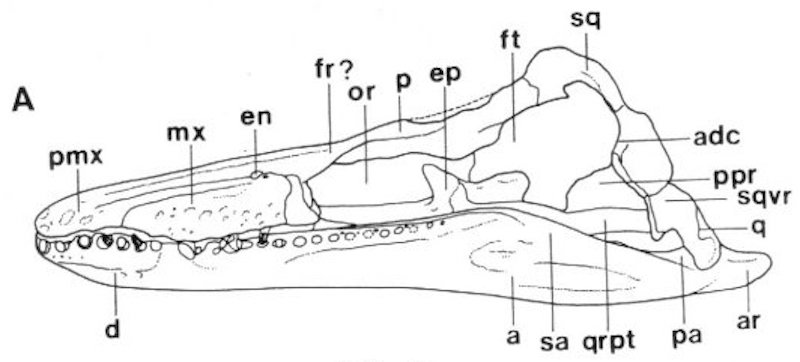
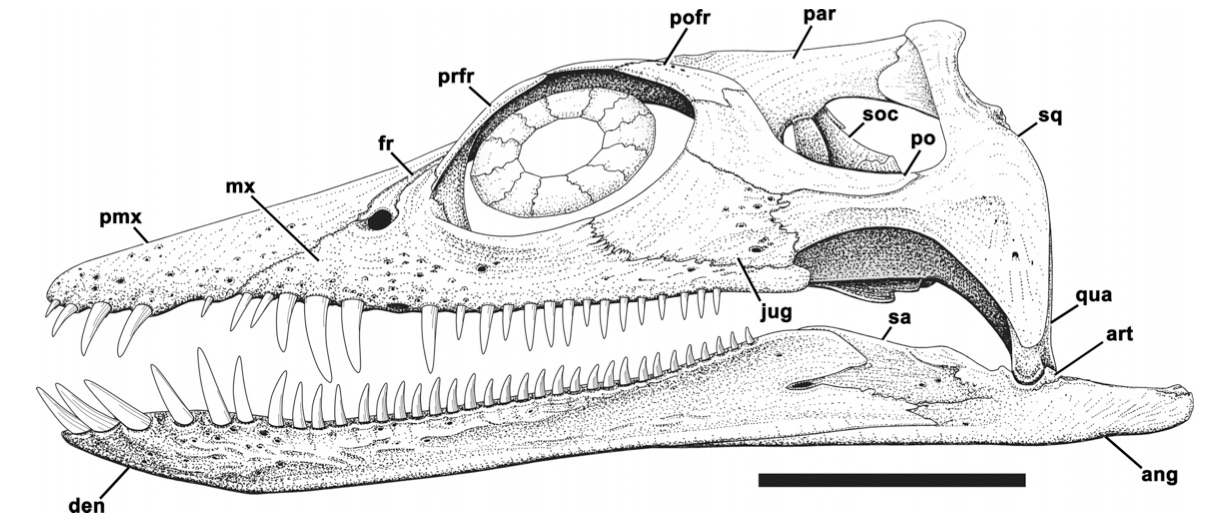
Stratesaurus skull reconstruction in lateral view. From Benson, Evans and Taylor (2015).

Stratesaurus is a very small-bodied basal plesiosaur known from the lowermost Jurassic (Blue Lias Formation) of Street, Somerset . Stratesaurus is represented by three specimens. The holotype specimen (OUMNH J.10337) was named and briefly described by Benson, Evans and Druckenmiller (2012), and later described in detail along with two referred specimens by…

Continue ReadingStratesaurus

Ogmodirus

Read more about the article Ogmodirus
'Ogmodirus' flipper (from Williston & Moodeie, 1917)

The type skeleton of 'Ogmodirus' was collected in 1909 by C. Boyce from the upper Greenhorn Limestone Formation (Lower Turonian, Upper Cretaceous) of Cloud County (near Aurora), Kansas (Storrs 1999, Schumacher and Everhart 2005). The specimen, KUVP 441, is a partial skeleton consisting of partial vertebral column (51 cervical vertebrae, 18 caudal vertebrae),…

Continue ReadingOgmodirus

Tricleidus

Read more about the article Tricleidus
Skull of Tricleidus in lateral view. From Brown (1981).

Tricleidus is a cryptoclidid from the Oxford Clay Formation of the UK. The holotype specimen (NHMUK R 3539) consists of disarticulated elements including most of skull and half the postcranium, from the Kosmoceras jasoni – Peltoceras athleta zones from the lowest deposits of the Oxford Clay Formation. The type and only species…

Continue ReadingTricleidus

Thililua

Read more about the article Thililua
Skull and neck of Thililua in right lateral view. From Bardet et. al. (2003).

Thililua has 30 cervical vertebrae. Each cervical has a longitudinal ridge on its lateral surfaces, this is a convergent feature with elasmosaurids. The skull of Thililua is relatively large with a short postorbital region and elongate rostrum. The type specimen (MHNGr.PA.11710) consists of a complete skull, entire cervical and pectoral series, and…

Continue ReadingThililua

Thalassiodracon

Read more about the article Thalassiodracon
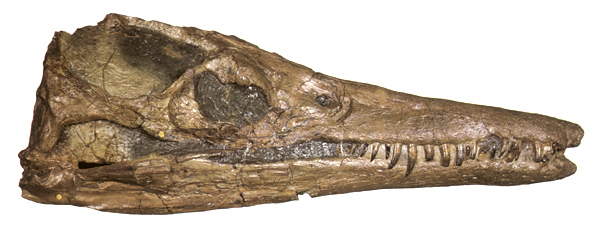
Thalassiodracon lectotype specimen (NHMUK 2018*).

The species Plesiosaurus hawkinsii was introduced in 1838 for a small plesiosaurian from Street, Somerset. The new genus name Thalassiodracon was erected decades later following an examination of a referred skull in Cambridge (CAMSM J.46986). Thalassiodracon is from the Rhaetian-Hettangian boundary, so it is latest Triassic or earliest Jurassic in age. Thalassiodracon…

Continue ReadingThalassiodracon

Simolestes

Simolestes has variously been allied with the Pliosauridae and the Rhomaleosauridae. The most noticeable difference between Simolestes and the other pliosaur taxa from the Oxford Clay (Liopleurodon, Peloneustes, Pachycostasaurus), is its much shorter snout and mandibular symphysis, a character is shares with the Rhomaleosauridae. However, this is probably a convergent character. Older…

Continue ReadingSimolestes

Rhomaleosaurus

Read more about the article Rhomaleosaurus
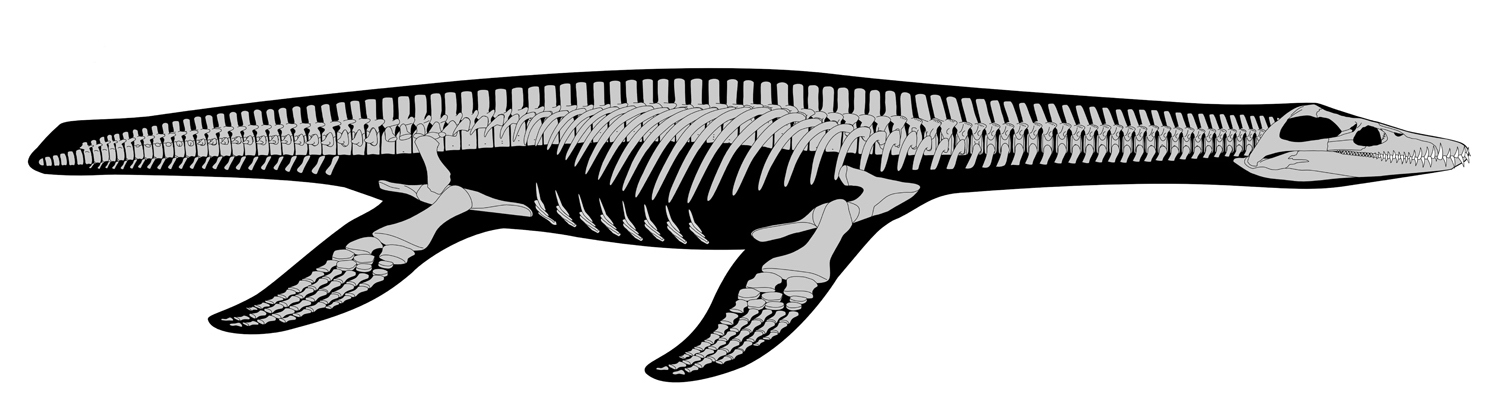
Reconstruction of Rhomaleosaurus thorntoni. From Smith and Benson (2014).

Rhomaleosaurus is the largest known Lower Jurassic pliosaur and was the top predator in early Jurassic marine ecosystems. It has a reinforced skull to help resist torsion and a ferocious set of teeth, a combination of characters perfect for snatching and killing cephalopods, fish, and other marine reptiles. Historically, the genus Rhomaleosaurus…

Continue ReadingRhomaleosaurus

Plesiosaurus

Read more about the article Plesiosaurus
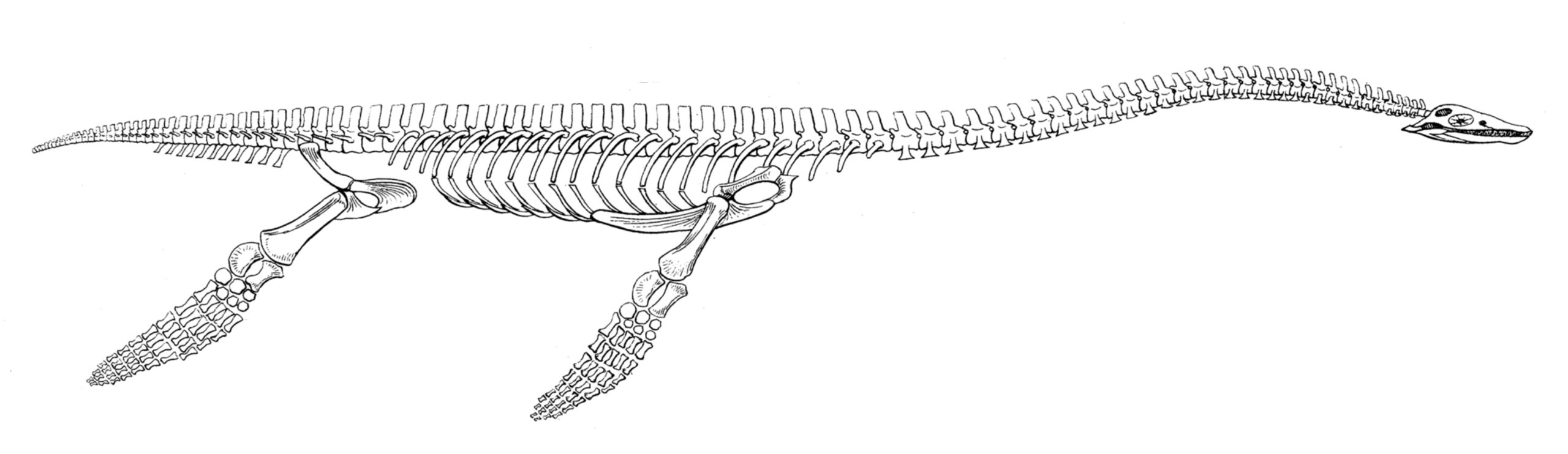
Reconstruction of Plesiosaurus dolichodeirus in lateral view. From Conybeare (1824).

Plesiosaurus was the first plesiosaur discovered and named (De la Beche and Conybeare 1821). The first 1821 description was based on partial remains so the anatomy of Plesiosaurus - particularly the identity of the isolated bones and how they articulated together – involved some guesswork. An attempted reconstruction of the forelimb of…

Continue ReadingPlesiosaurus

Pachycostasaurus

Read more about the article Pachycostasaurus
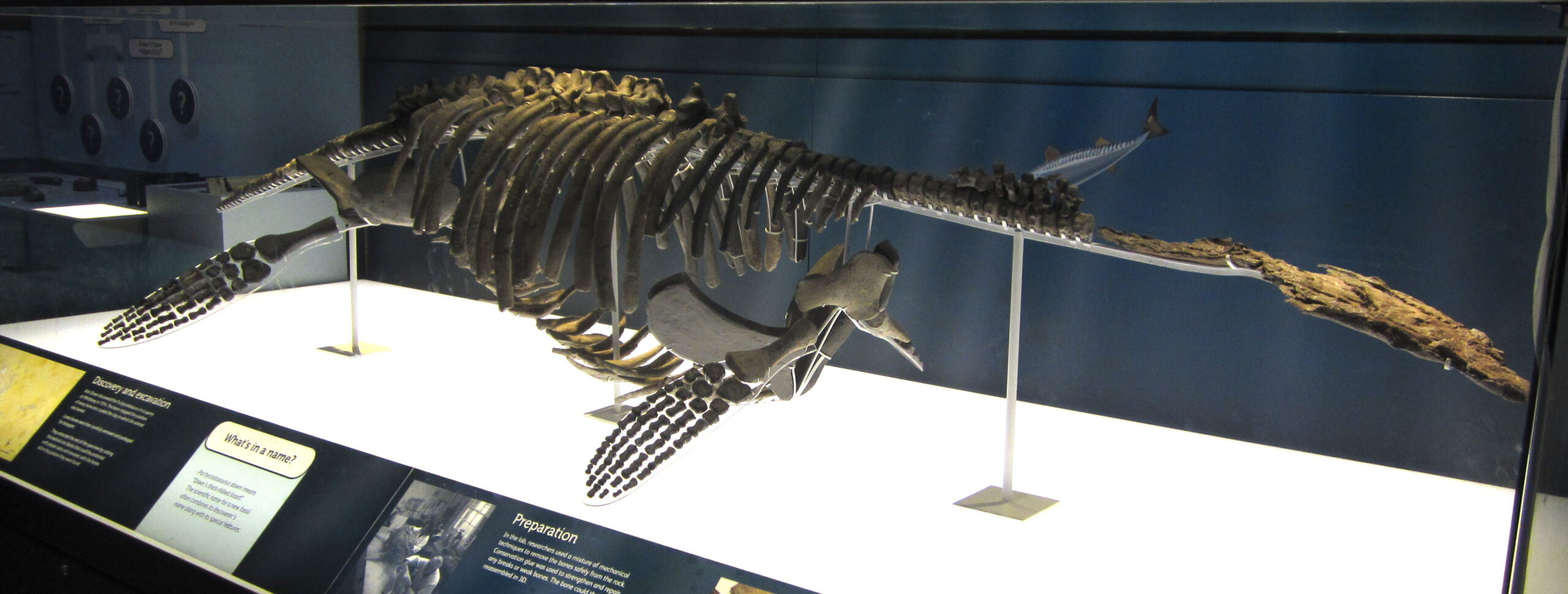
Mounted skeleton of Pachycostasaurus in the Peterborough Museum. Photo by Adam Smith.

Pachycostasaurus is approximately 3.1 meters long. Its rib cage and vertebrae exhibit thickened bone (Cruickshank et al. 1996) a condition termed pachyostosis. This heavy ossification is unusual in plesiosaurs (another exception may include Kronosaurus), although it is common in basal sauropterygians, especially pachypleurosaurs. Pachycostasaurus probably used the extra ballast provided by its…

Continue ReadingPachycostasaurus

Occitanosaurus

Read more about the article Occitanosaurus
Mounted skeleton of 'Occitanosaurus'. From a postcard.

'Occitanosaurus' was described by Sciau et al. (1990) and Bardet et al. (1999). The genus name was erected for 'Plesiosaurus' tournemirensis by Bardet et al. (1999). The taxon was originally regarded as an early elasmosaurid but is now considered a member of the Microcleididae. 'Occitanosaurus' was approximately 3.9 meters long. The type…

Continue ReadingOccitanosaurus

Morturneria

Read more about the article Morturneria
Skull of Morturneria in lateral view. From Chaterjee and Small (1989).

The taxon was originally named 'Turneria seymourensis' by Chatterjee and Small (1989) but this genus was preoccupied and so Chatterjee and Creisler (1994) later revised the name to Morturneria seymourensis. The holotype specimen is TTU P 9219, an incomplete skull and mandible plus associated cervical vertebrae, from the Lopez de Bertodano Formation…

Continue ReadingMorturneria