
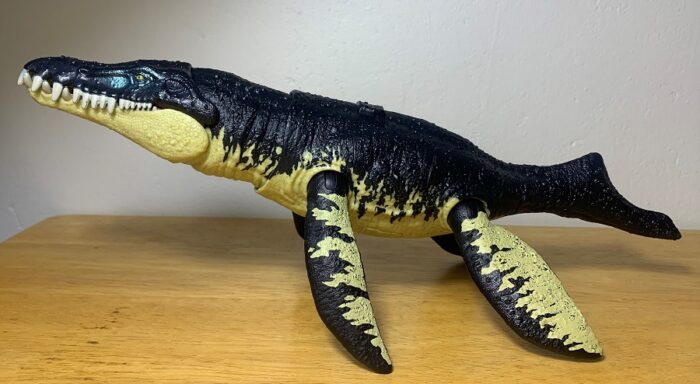
I need to catch up on several more years of new plesiosaur models. The notable new company on the block is PNSO, the Peking Nature-Science Organisation, although having pushed out an impressively prolific catalogue of prehistoric animal models, to date they have produced only one commercially available plesiosaur figure, a Kronosaurus in 2021.
Category «Elasmosaurus»
The University of British Columbia’s new Elasmosaurus

The University of British Columbia have erected a spectacular 13-metre-long Elasmosaurus skeleton in their Pacific Museum of Earth. The resin reconstruction was suspended in the Wheaton Precious Metals Atrium of the University’s Earth Sciences Building earlier this month (15th-16th September 2018).
Elasmosaurus

Elasmosaurus is one of the most widely recognised plesiosaur names and has become a stereotype for all elasmosaurids. However, it is relatively poorly known. The type and only known specimen of Elasmosaurus platyurus (ANSP 10081) includes the tip of the snout, occipital condyle, and the majority of the vertebral column.
Book review: Sticks ‘N’ Stones ‘N’ Dinosaur Bones
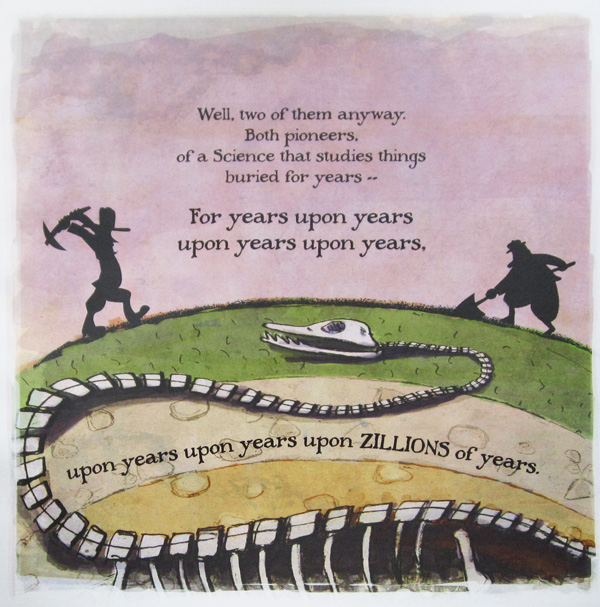
“I’ll tell you a story — and some of it’s true —
that explores and explains
what the Bone-Hunters do.”
You’re probably already familiar with the Bone Wars, or the Great Dinosaur Rush, but you won’t have seen this real-life rivalry between two prolific 19th century palaeontologists portrayed quite like this before.
that explores and explains
what the Bone-Hunters do.”
You’re probably already familiar with the Bone Wars, or the Great Dinosaur Rush, but you won’t have seen this real-life rivalry between two prolific 19th century palaeontologists portrayed quite like this before.
Elasmosaurus to feature in new exhibit (PART 2)
A special exhibition entitled “Collecting Oklahoma” opened in the Sam Noble Oklahoma Museum of Natural History, on the 16th of June 2007. The exhibition features an original painting of an Elasmosaurus by artist Debby Cotter Kaspari. The exhibit was curated by Rick Lupia, the project coordinator was Deborah Kay, and Tom Luczycki was the exhibits director.
Elasmosaurus to feature in new exhibit (PART 1)
Artist Debby Cotter Kaspari has produced an Elasmosaurus painting as part of a special exhibition in the Sam Noble Oklahoma Museum of Natural History entitled “Collecting Oklahoma”, scheduled to open on the 16th of June 2007. The exhibit will present a selection of rare and unique specimens collected around Oklahoma by the museum over the last decade.