Ogmodirus

Read more about the article Ogmodirus
'Ogmodirus' flipper (from Williston & Moodeie, 1917)

The type skeleton of ‘Ogmodirus’ was collected in 1909 by C. Boyce from the upper Greenhorn Limestone Formation (Lower Turonian, Upper Cretaceous) of Cloud County (near Aurora), Kansas (Storrs 1999, Schumacher and Everhart 2005). The specimen, KUVP 441, is a partial skeleton consisting of partial vertebral column (51 cervical vertebrae, 18 caudal vertebrae), limb, and girdle elements. Originally named...

Continue ReadingOgmodirus

Thililua

Read more about the article Thililua
Skull and neck of Thililua in right lateral view. From Bardet et. al. (2003).

Thililua has 30 cervical vertebrae. Each cervical has a longitudinal ridge on its lateral surfaces, this is a convergent feature with elasmosaurids. The skull of Thililua is relatively large with a short postorbital region and elongate rostrum. The type specimen (MHNGr.PA.11710) consists of a complete skull, entire cervical and pectoral series, and the first four dorsal vertebrae. Skull and neck...

Continue ReadingThililua

Thalassomedon

The holotype of Thalassomedon was discovered by R. L. Landberg in 1939 in Baca County, Colorado. Thalassomedon has a short and deep atlas-axis and 62 cervical vertebrae, and there is no pectoral or pelvic bar in the adult condition (Carpenter 1999). The species name haningtoni is sometimes wrongly spelled ‘hanningtoni’ (as in Carpenter 1999) or ‘haringtoni’ (as in the AMNH...

Continue ReadingThalassomedon

Morturneria

Read more about the article Morturneria
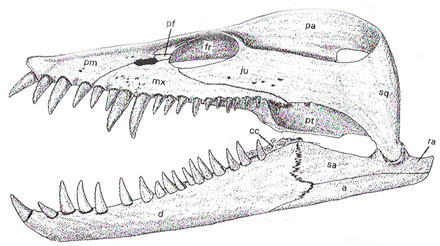
Skull of Morturneria in lateral view. From Chaterjee and Small (1989).

The taxon was originally named ‘Turneria seymourensis‘ by Chatterjee and Small (1989) but this genus was preoccupied and so Chatterjee and Creisler (1994) later revised the name to Morturneria seymourensis. The holotype specimen is TTU P 9219, an incomplete skull and mandible plus associated cervical vertebrae, from the Lopez de Bertodano Formation of Seymour Island, Antarctica. Morturneria was regarded by...

Continue ReadingMorturneria

Libonectes

Libonectes was erected for ‘Elasmosaurus morgani’. The pectoral girdle and a forelimb of the holotype are figured (most recently by Welles 1962, fig. 12) but now lost (Carpenter 1999). Libonectes morgani (Welles 1949) is the type and only species. Type material of L. morgani (SMUSMP 69120) consists of a skull, cervical vertebrae and gastralia, from the Britton Formation, Eagle...

Continue ReadingLibonectes

Leptocleidus

Read more about the article Leptocleidus
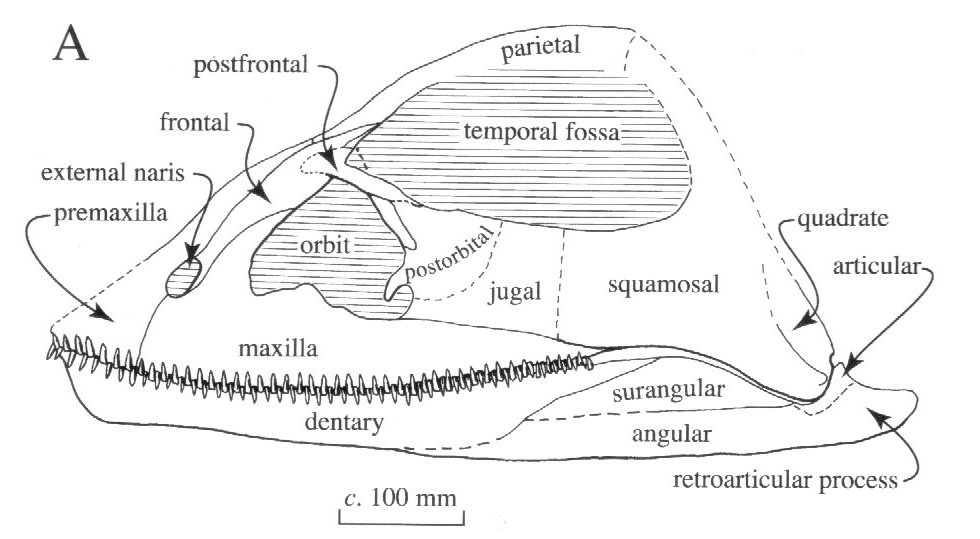
Skull of Leptocleidus capensis in lateral view (from Cruickshank, 1997)

Lower Cretaceous plesiosaurs are rare, so Leptocleidus is important because it fills a gap in the fossil record of plesiosaurians. Leptocleidus was once considered to be a late surviving member of the family Rhomaleosauridae but it has recently been reidentified as a close relative of polycotylids. The fossils of all known species of Leptocleidus were preserved in inshore brackish or...

Continue ReadingLeptocleidus

Kronosaurus

Read more about the article Kronosaurus
Kronosaurus queenslandicus skeleton in lateral view.

Due to its large size and ferocious appearance, Kronosaurus is one of the most famous plesiosaurs. The iconic skeleton referred to Kronosaurus on display in the Museum of Comparative Zoology in Harvard is nicknamed ‘plasterosaurus’ because so much of it is reconstructed in plaster. About a third of the skeleton is plaster and there are at least seven vertebrae too...

Continue ReadingKronosaurus

Kaiwhekea

Kaiwhekea, also known as the ‘Shag Point Plesiosaur’, was classified as a cryptoclidid by Cruickshank and Fordyce (2002). More recent classifications regard it as an aristonectid. It has an unusually large number of small needle-like teeth and a shortened snout, much like the closely related Aristonectes. Kaiwhekea katiki is the type and only species. Reconstruction of the skull of Kaiwhekea...

Continue ReadingKaiwhekea

Hydrotherosaurus

Read more about the article Hydrotherosaurus
Articulated skeleton of Hydrotherosaurus. From Welles 1943.

Hydrotherosaurus is a long-necked elasmosaurid from California, USA. It is represented by one of the most complete elasmosaurid skeletons ever discovered, so Hydrotherosaurus is one of the best known members of this family. The almost complete type skeleton of Hydrotherosaurus was discovered in the Panoche Hills by Mr. Frank C. Paiva in 1937, and was excavated by the University of...

Continue ReadingHydrotherosaurus

Elasmosaurus

Read more about the article Elasmosaurus
Skeleton of Elasmosaurus from Cope (1869, revised version)

Elasmosaurus is one of the most widely recognised plesiosaur names and has become a stereotype for all elasmosaurids. However, it is relatively poorly known. The type and only known specimen of Elasmosaurus platyurus (ANSP 10081) includes the tip of the snout, occipital condyle, and the majority of the vertebral column. It is from the Sharon Springs Member (Lower Campanian) of...

Continue ReadingElasmosaurus