
Abyssosaurus is a derived cryptoclidid plesiosaur from the Upper Hauterivian (Lower Cretaceous) of the Menya River, Chuvashia, Russia. It was named and described in 2011 by Alexander Yu Berezin (Berezin 2011). A partial skull associated with the holotype specimen (MChEIO no. PM/1 MChEIO no. PM.1) was not described in the original 2011 paper but was discovered later in a compact area near the pectoral girdle and cervical vertebrae 20–22. The skull material was subsequently described in detail in a separate paper (Berezin 2018).
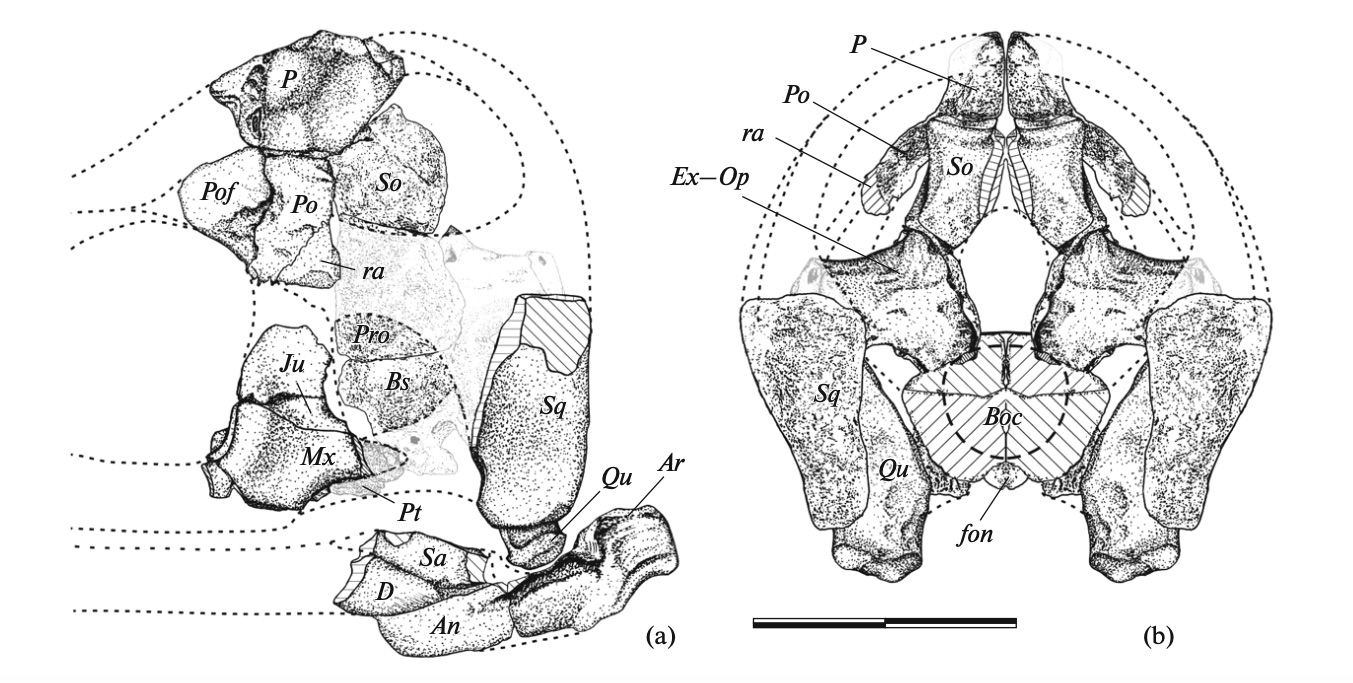
Using a traditional classification system Berezin (2011) ascribed Abyssosaurus to the Aristonectidae and described it as an intermediate form between Jurassic cryptoclidids and the Cretaceous aristonectids Kaiwhekea and Aristonectes. However, aristonectids are now classified as elasmosaurs rather than cryptoclidids, and cladistic analyses of plesiosaurs that included Abyssosaurus have resolved it as a cryptoclidid (Benson and Druckenmiller 2014). This prompted Berezin (2018) to reclassify Abyssosaurus as a derived and specialised cryptoclidid. Abyssosaurus is the youngest known Cretaceous representative of Cryptoclididae.
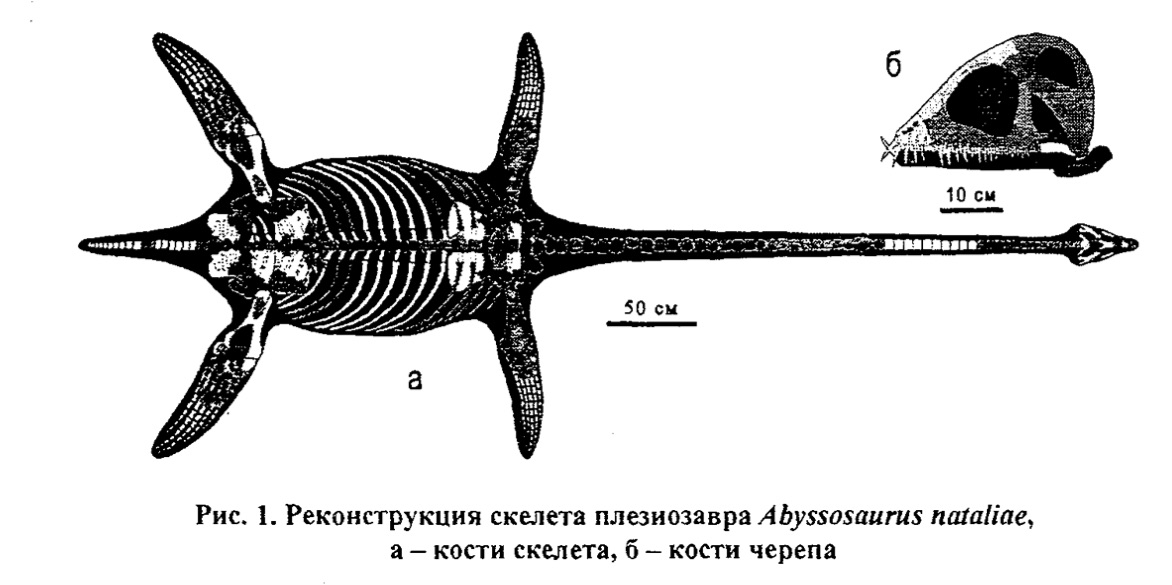
Berezin (2016) presented a full body reconstruction of Abyssosaurus in 2016, and suggested a deep-sea lifestyle for it on the basis of several morphological characters (Berezin 2016, Berezin 2019). It has an osteologically immature (paedomorphic) adult skeleton including a short and deep skull. Its hind fins are larger than its forefins. These may be specialist adaptations associated with hunting and feeding on soft-bodied prey in soft deep-sea sediments.
Abyssosaurus nataliae is the type and only species of Abyssosaurus.