
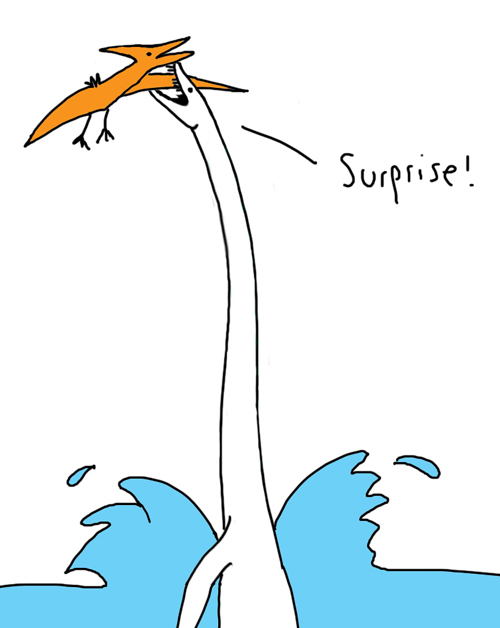
It was once common knowledge that elasmosaurid plesiosaurs were bendy-necked beasts that swanned about near the surface, striking snake-like at slippery prey. It is now common knowledge that their necks were relatively rigid rod-like structures, the function of which remains something of a mystery.
Category «Plesiosauroidea»
Book review: Plesiosaur Peril by Daniel Loxton
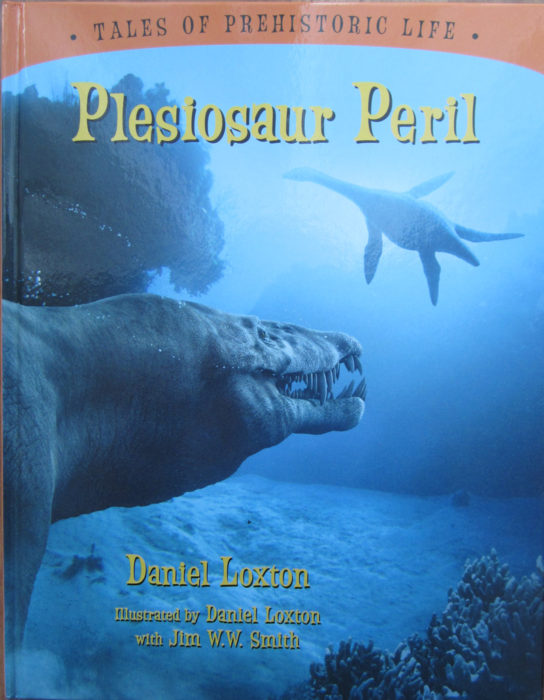
In Plesiosaur Peril, author Daniel Loxton plunges us into the Jurassic ocean, to recount a day in the life of a baby Cryptoclidus. The book is the third in Loxton’s ‘Tales of Prehistoric Life’ series, which includes the stories Ankylosaur Attack and Pterosaur Troubles.
Prepared ‘Kreis Hoxter plesiosaur’ is new taxon
I previously reported (see here and here) on the plesiosauroid skeleton discovered in 2007 in Kreis Hoxter, near Bielefeld, Northern Germany. The specimen was excavated from the Pliensbachian (Lower Jurassic) age strata in ten large blocks by the LWL-Museum für Naturkunde, Münsterand.
The name game: Plesiosaur-ia, -oidea, -idae, or -us?
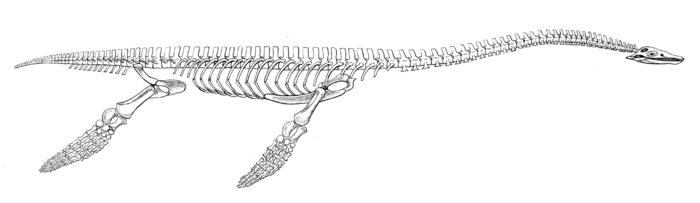
Proper taxonomic names, with formal suffixes, can be confusing at the best of times. But when they include identical prefixes their meaning can be further complicated. For example, to what taxonomic group does the colloquial term ‘plesiosaur’ refer: Plesiosauria, Plesiosauroidea, Plesiosauridae, or Plesiosaurus?
Update on the ‘Kreis Hoxter plesiosaur’
I reported in Summer 2007 on a four-metre-long plesiosaur skeleton that was discovered in Kreis Hoxter, near Bielefeld, Northern Germany by amateur collector Sönke Simonsen. I can now provide a short update on the fossil. The specimen was successfully excavated in ten large blocks by the LWL-Museum für Naturkunde, Münsterand, where preparation of the skeleton is well underway.
Long-necked plesiosaur discovered in northern Germany
A four-metre-long plesiosaur skeleton has been discovered by in Northern Germany by an amateur palaeontologist. 19-year-old fossil collector Sönke Simonsen discovered the specimen in June whilst looking for fossils with his dad in a quarry at Tongrube in Kreis Hoxter, near Bielefeld.
Hydrorion – a new plesiosaur from Germany
The most recent issue of the ‘Palaeontology’ (Vol 49, Part 3) features an article by Franziska Grossman on the plesiosauroids from the Jurassic Posidonia Shale in Germany. Grossman describes the skulls of two genera, Seeleyosaurus guilelmiimperatoris (a tongue-twister of a taxon!
Research suggests long-necked plesiosaurs fed on seabed
The long neck of the plesiosaur is a mysterious adaptation for which many hypotheses have been proposed. The most recent suggestion comes from Dr Leslie Noè of the University of Cambridge . After examining the neck vertebrae of the long-necked plesiosaur Muraenosaurus, whose name translates as ‘Moray eel lizard’, Dr Noè concluded that the natural position of the neck was a downwards curve towards the seabed.