AGT uncatalogued
A partial postcranial skeleton from Street, Somerset, UK (likely lowermost Hettangian)....

A partial postcranial skeleton from Street, Somerset, UK (likely lowermost Hettangian)....
A partial skeleton including a damaged skull. Suffering from pyrite decay....
A partial skeleton including the skull (but no mandible) (Smith 2007a, Benson et al. 2012)...
A substantially complete skeleton exposed in dorsal view. The specimen was proposed as a neotype for Rhomaleosaurus megacephalus (= Atychodracon megacephalus) (Cruickshank 1994b). This fossil, nicknamed the ‘Barrow Kipper’ after Barrow-upon-Soar where it was discovered (Taylor and Martin 1990), is on display at the New Walk Museum in Leicester, UK. This specimen has since become a referred specimen (Smith 2015)....
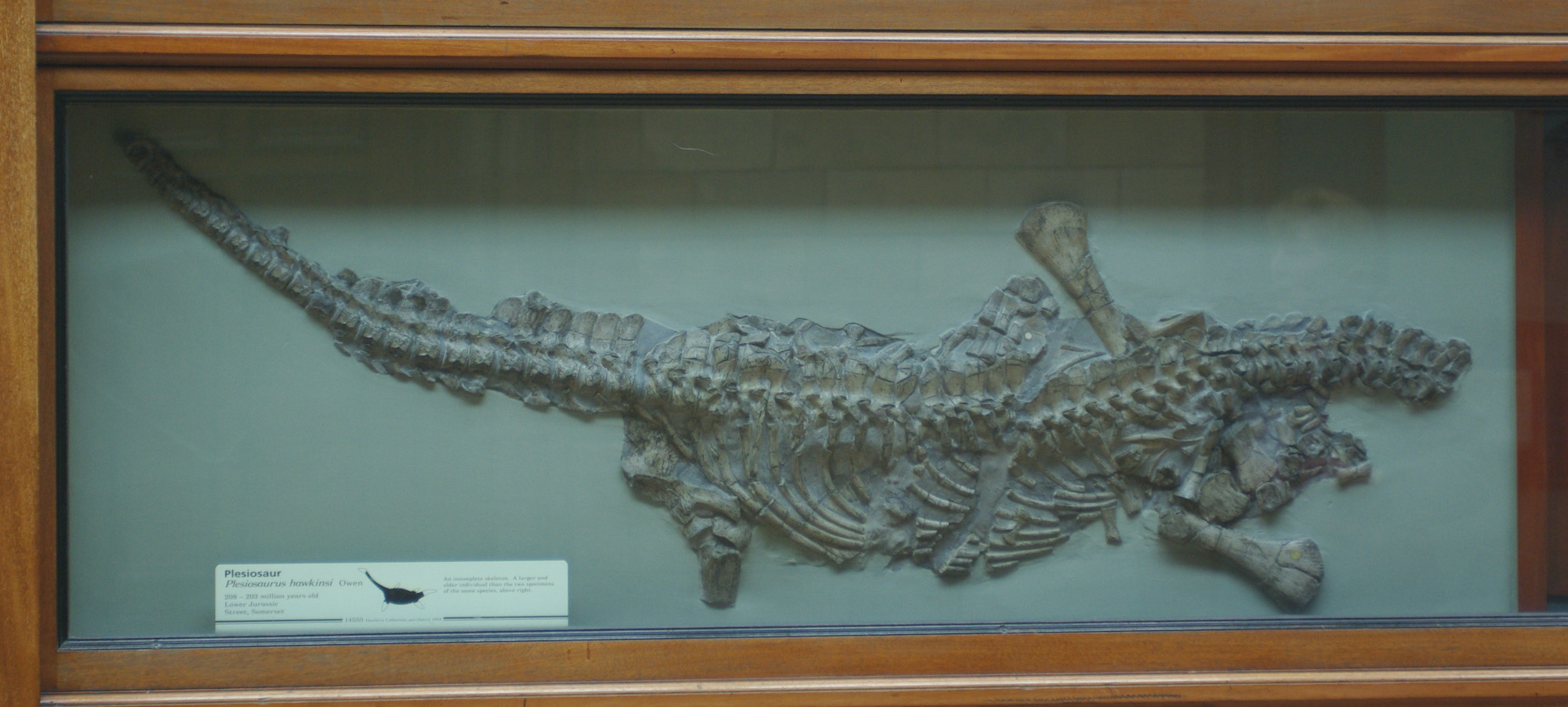
Avalonnectes is a small-bodied basal rhomaleosaurid. Avalonnectes was named by Benson, Evans and Druckenmiller (2012) for a partial skeleton including the rear part of the skull from the lowermost Jurassic of Street, Somerset, UK. The specimen (NHMUK PV OR 14550) was previously referred to Thalassiodracon hawkinsii and is one of many historical plesiosaur skeletons preserved on slabs on display in...
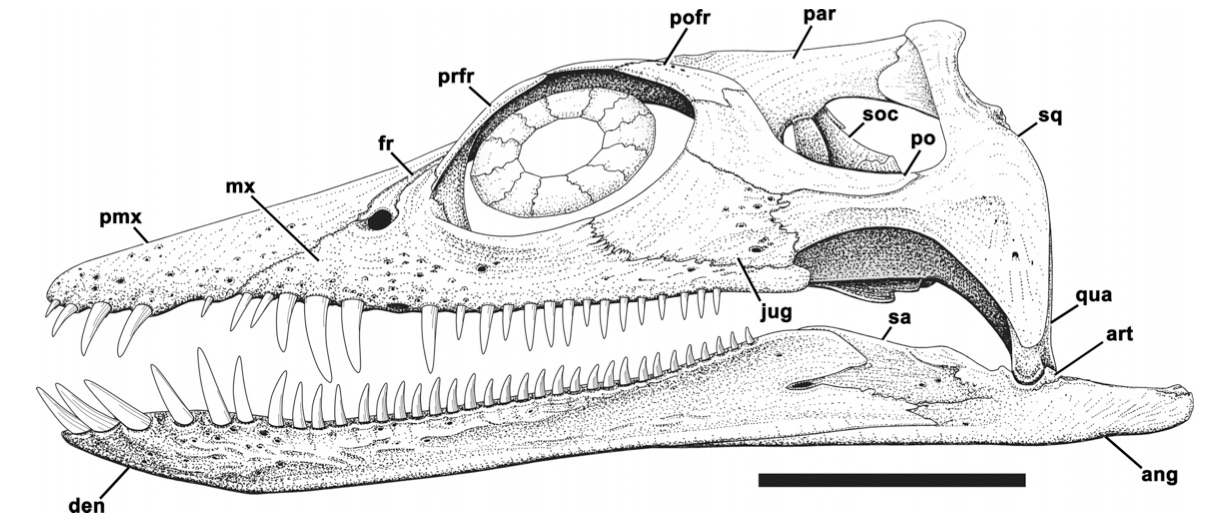
Stratesaurus is a very small-bodied basal plesiosaur known from the lowermost Jurassic (Blue Lias Formation) of Street, Somerset . Stratesaurus is represented by three specimens. The holotype specimen (OUMNH J.10337) was named and briefly described by Benson, Evans and Druckenmiller (2012), and later described in detail along with two referred specimens by Benson, Evans and Taylor (2015). The genus contains...

The species Plesiosaurus hawkinsii was introduced in 1838 for a small plesiosaurian from Street, Somerset. The new genus name Thalassiodracon was erected decades later following an examination of a referred skull in Cambridge (CAMSM J.46986). Thalassiodracon is from the Rhaetian-Hettangian boundary, so it is latest Triassic or earliest Jurassic in age. Thalassiodracon means ‘Sea Dragon’, which “alludes to the colloquial...
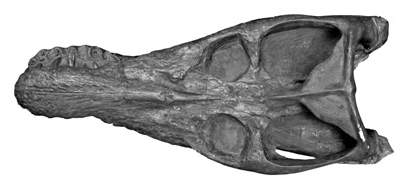
Macroplata is a rhomaleosaurid plesiosaur from the Lower Jurassic of Warwickshire, UK. Macroplata was named and briefly described by Swinton (1930a) based on a single skeleton from Harbury, Warwickshire, and the skeleton was redescribed in detail by Ketchum and Smith (2010). Photograph of Macroplata tenuiceps in situ in Harbury, Warwickshire. White (1940) referred the species Plesiosaurus longirostris to Macroplata, and...

The genus Atychodracon was erected by Smith (2015) to accommodate ‘Rhomaleosaurus’ megacephalus, because it is generically separarate from Rhomaleosaurus sensu stricto (Smith and Dyke 2008). A. megacephalus is closely related to Eurycleidus and some authors have regarded A. megacephalus as a distinct species of Eurycleidus. Three dimensional scan with texture (colour) removed of plaster cast (BGS GSM 118410) of the...