Dolichorhynchops

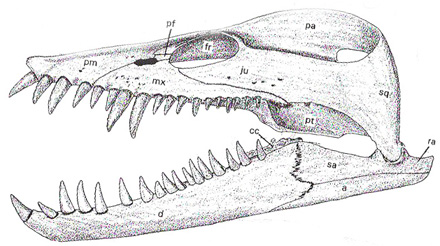
Williston (1903) originally diagnosed Dolichorhynchops as follows: “Head elongate, the facial region much attenuated; teeth nearly uniform in size, small; prefrontals and postfrontal bones not joined; parietals extending into a high crest; supraocciptial bones separated; internal nares small, included between the vomer and the palatine only; palatines broadly separated throughout; a large vacuity between the pterygoids anteriorly; quadrate process of...
Continue ReadingDolichorhynchops

Polycotylus

Read more about the article Polycotylus
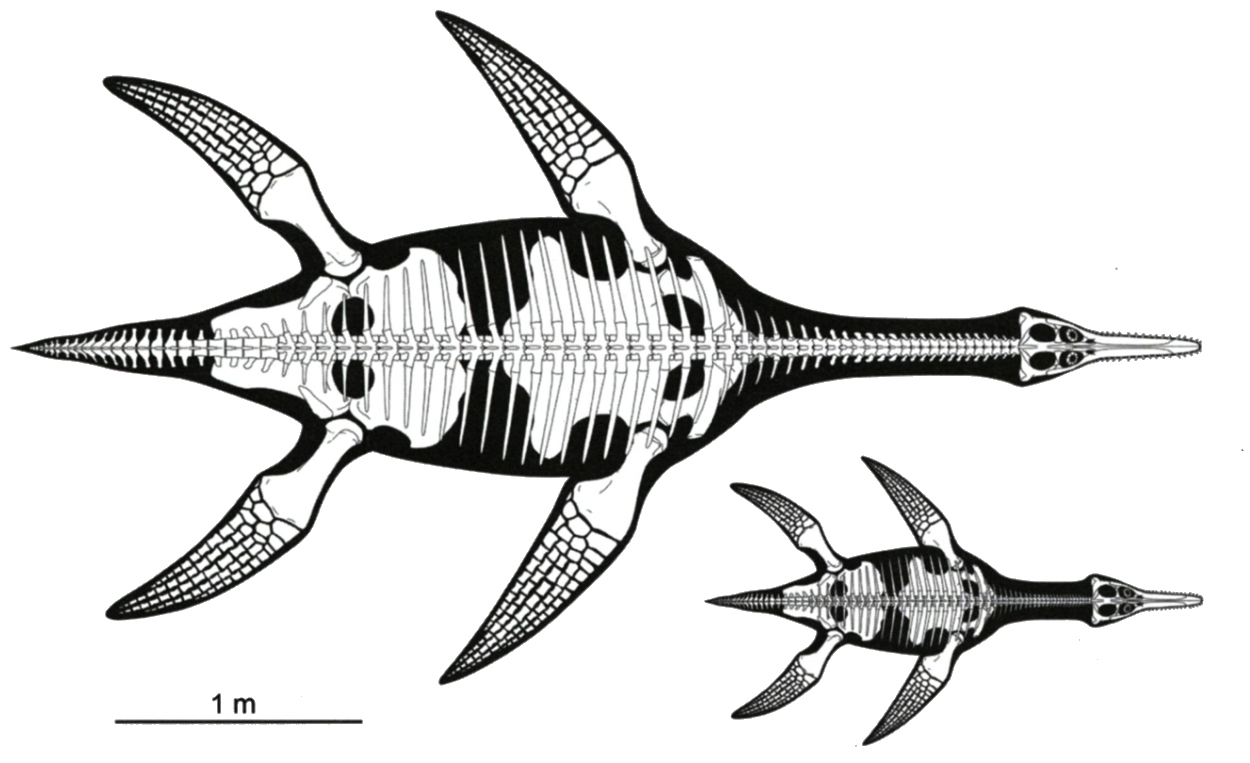
Reconstruction of an adult and a newborn baby Polycotylus. From O'Keefe and Chiappe (2011).

Polycotylus latipinnis was the first short-necked plesiosaur to be recognised in North America (Carpenter 1996), and the first polycotylid to be described and named (Cope 1869). It was established in the same volume that coined the name Elasmosaurus and contained the infamous ‘head on the wrong end’ reconstruction (Cope 1869). However, despite their equally long history, Polycotylus never achieved the...

Continue ReadingPolycotylus

Nakonanectes

Read more about the article Nakonanectes
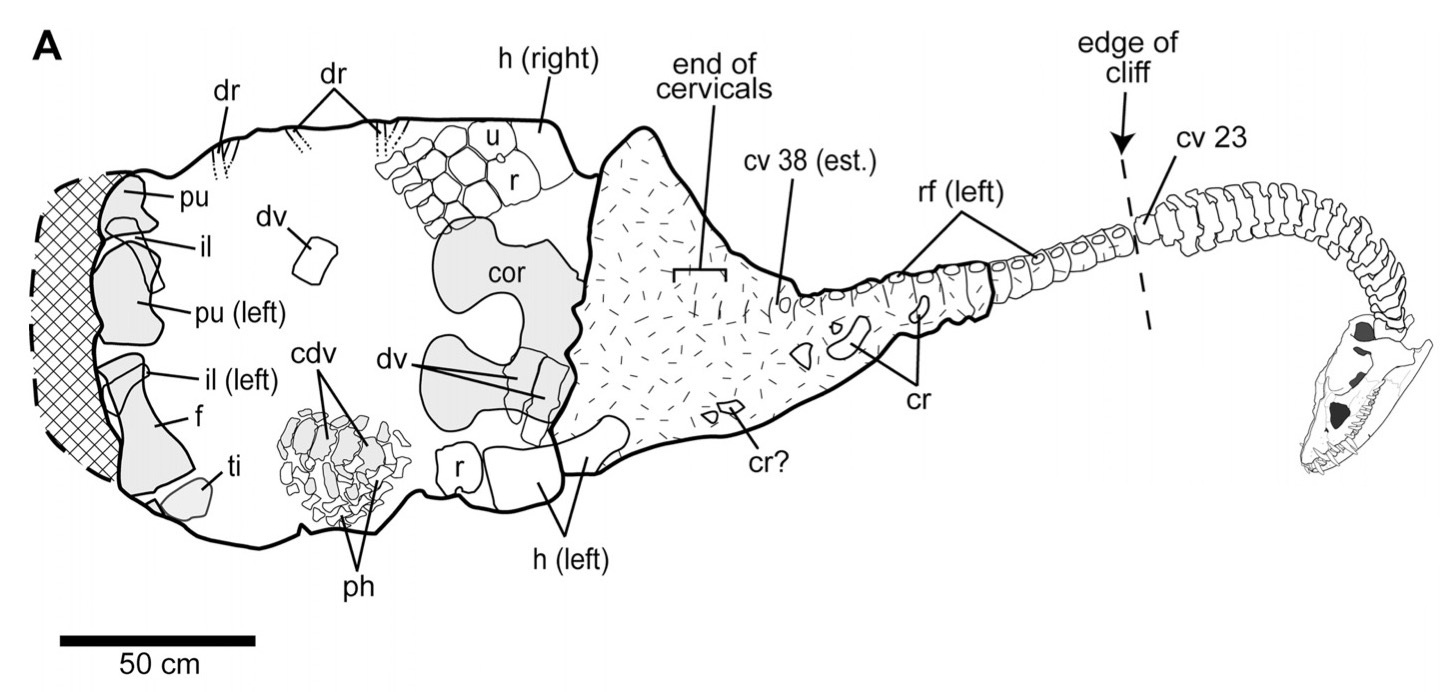
The articulated type specimen of Nakonanectes. From Serratos et al. (2017)

Nakonanectes is a small elasmosaurid plesiosaur from the Bearpaw Shale of Montana, USA. It is known from a single moderately complete specimen including a particularly fine skull. It has a relatively short neck for an elasmosaur consisting of ‘only’ 39-42 neck vertebrae. However, 16–19 of the neck vertebrae were lost in a “heavy spring runoff that occurred between the time...

Continue ReadingNakonanectes

Styxosaurus

Read more about the article Styxosaurus
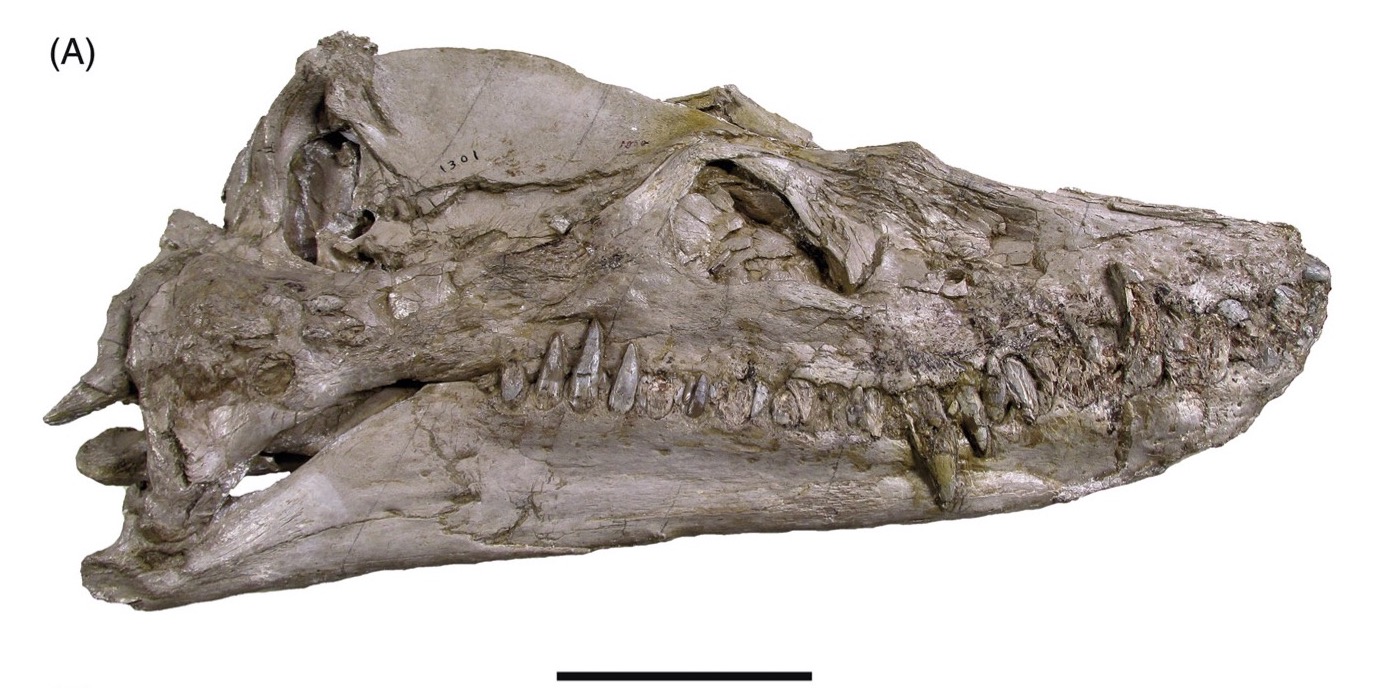
Styxosaurus snowii holotype skull, right side. Scale bar = 10cm. From Sachs et al. (2018).

The holotype specimen (KUVP 1301) of Styxosaurus is an articulated skull and anterior portion of the neck. It was found in the Niobrara Chalk near Hell Creek, Logan County, Western Kansas in 1890. It was described later that year as a new species Cimoliosaurus snowii by Williston (1890a) (and in more detail soon after by Williston 1890b), who subsequently...

Continue ReadingStyxosaurus

Ogmodirus

Read more about the article Ogmodirus
'Ogmodirus' flipper (from Williston & Moodeie, 1917)

The type skeleton of ‘Ogmodirus’ was collected in 1909 by C. Boyce from the upper Greenhorn Limestone Formation (Lower Turonian, Upper Cretaceous) of Cloud County (near Aurora), Kansas (Storrs 1999, Schumacher and Everhart 2005). The specimen, KUVP 441, is a partial skeleton consisting of partial vertebral column (51 cervical vertebrae, 18 caudal vertebrae), limb, and girdle elements. Originally named...

Continue ReadingOgmodirus

Thalassomedon

The holotype of Thalassomedon was discovered by R. L. Landberg in 1939 in Baca County, Colorado. Thalassomedon has a short and deep atlas-axis and 62 cervical vertebrae, and there is no pectoral or pelvic bar in the adult condition (Carpenter 1999). The species name haningtoni is sometimes wrongly spelled ‘hanningtoni’ (as in Carpenter 1999) or ‘haringtoni’ (as in the AMNH...

Continue ReadingThalassomedon

Libonectes

Libonectes was erected for ‘Elasmosaurus morgani’. The pectoral girdle and a forelimb of the holotype are figured (most recently by Welles 1962, fig. 12) but now lost (Carpenter 1999). Libonectes morgani (Welles 1949) is the type and only species. Type material of L. morgani (SMUSMP 69120) consists of a skull, cervical vertebrae and gastralia, from the Britton Formation, Eagle...

Continue ReadingLibonectes

Hydrotherosaurus

Read more about the article Hydrotherosaurus
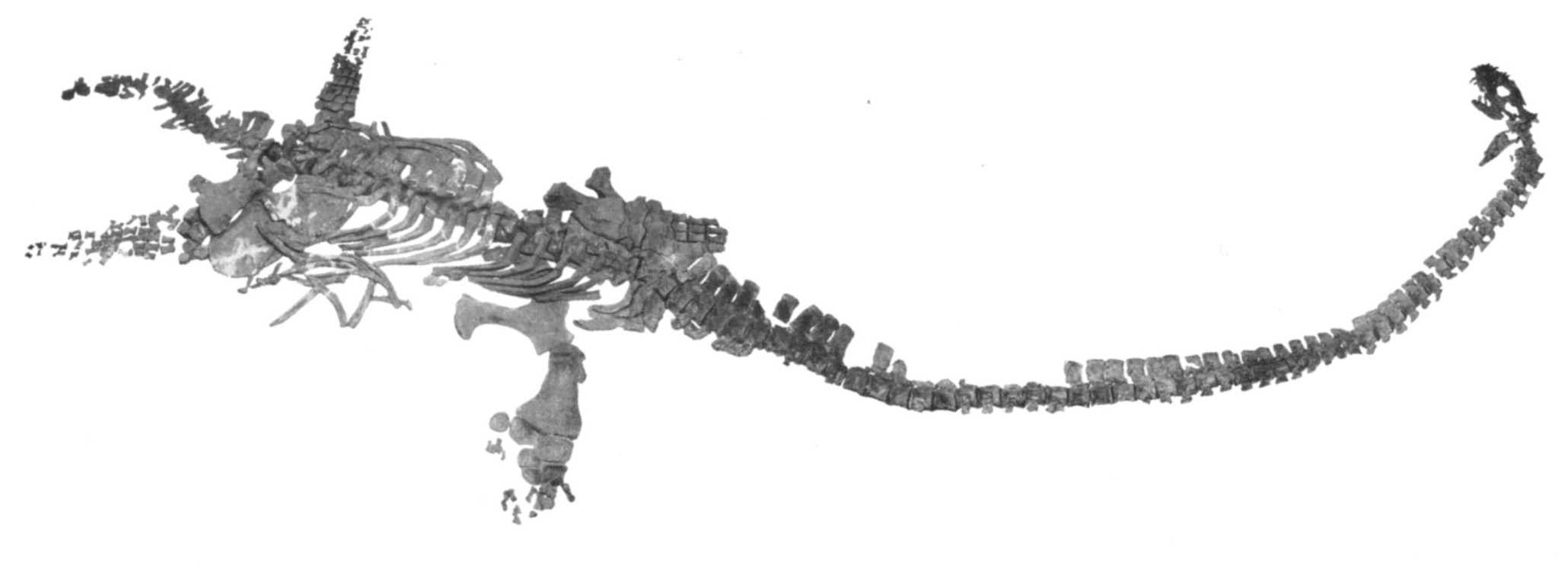
Articulated skeleton of Hydrotherosaurus. From Welles 1943.

Hydrotherosaurus is a long-necked elasmosaurid from California, USA. It is represented by one of the most complete elasmosaurid skeletons ever discovered, so Hydrotherosaurus is one of the best known members of this family. The almost complete type skeleton of Hydrotherosaurus was discovered in the Panoche Hills by Mr. Frank C. Paiva in 1937, and was excavated by the University of...

Continue ReadingHydrotherosaurus

Elasmosaurus

Read more about the article Elasmosaurus
Skeleton of Elasmosaurus from Cope (1869, revised version)

Elasmosaurus is one of the most widely recognised plesiosaur names and has become a stereotype for all elasmosaurids. However, it is relatively poorly known. The type and only known specimen of Elasmosaurus platyurus (ANSP 10081) includes the tip of the snout, occipital condyle, and the majority of the vertebral column. It is from the Sharon Springs Member (Lower Campanian) of...

Continue ReadingElasmosaurus