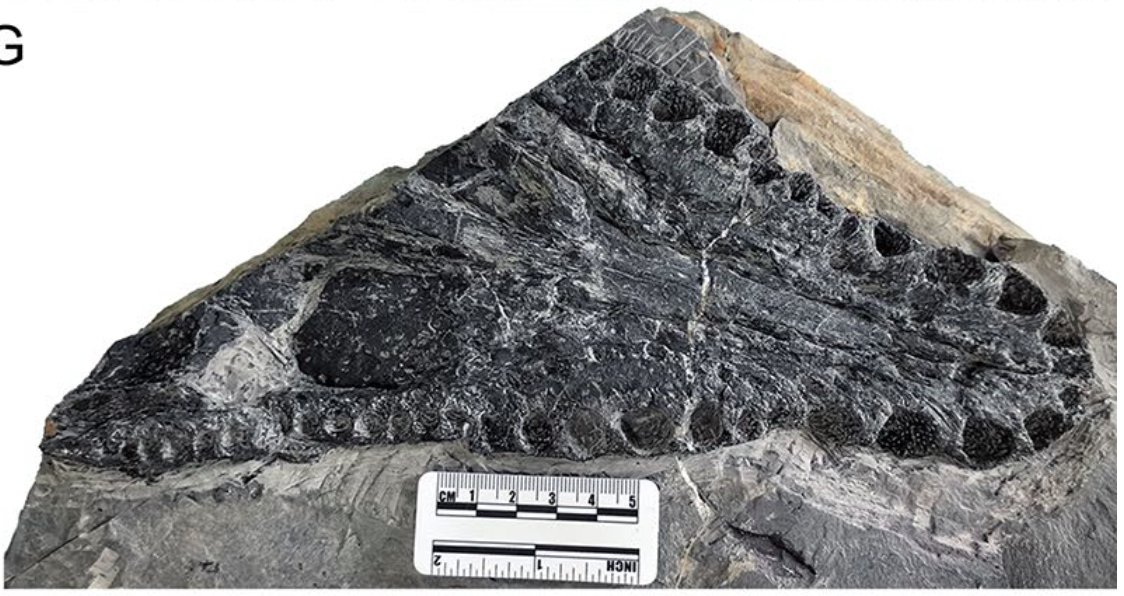
Bishanopliosaurus
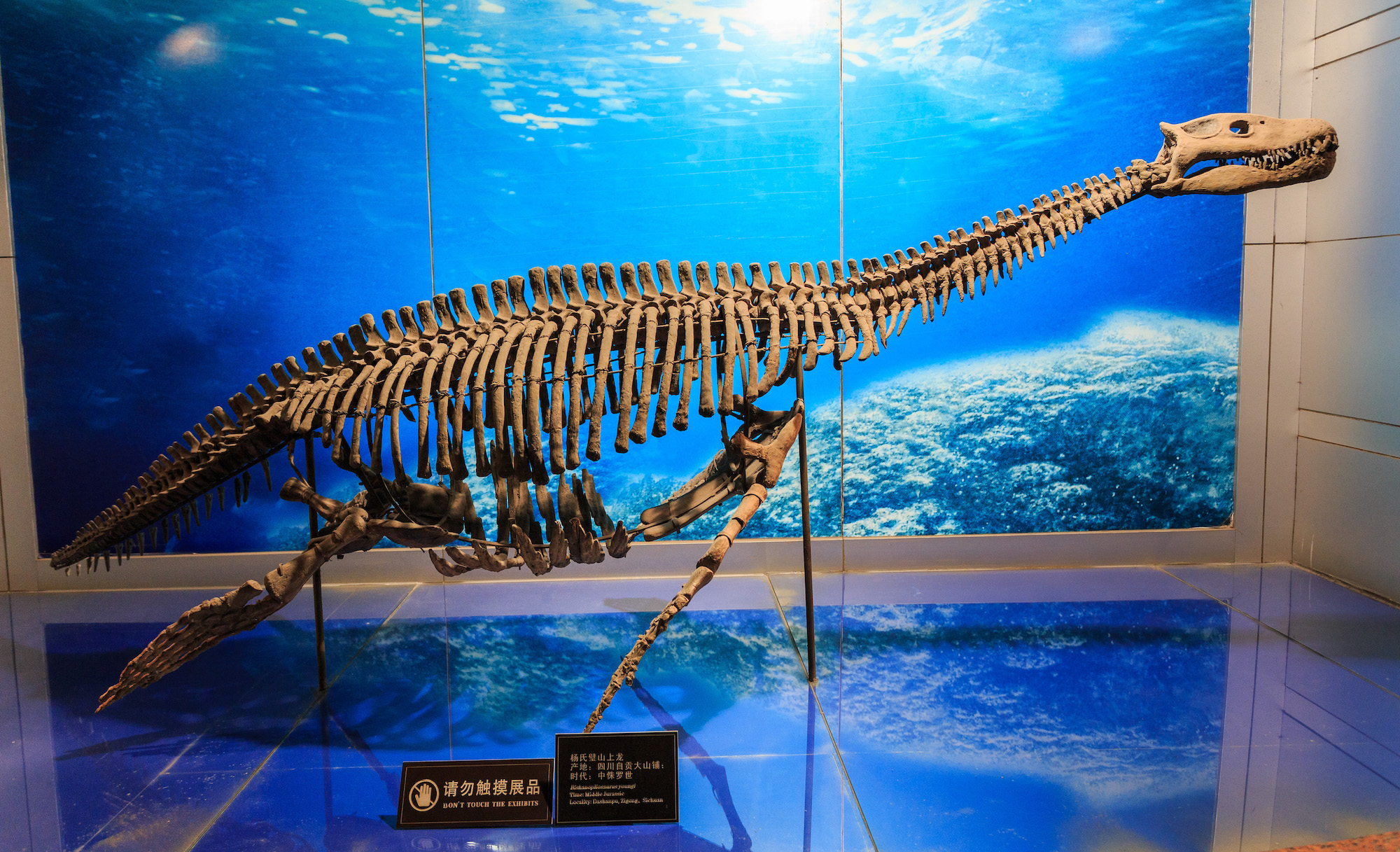
B. youngi
Bishanopliosaurus is the most complete plesiosaur known from the Jurassic of Asia (Sato et al. 2003). The holotype specimen of the type species, B. youngi, is a partial postcranial skeleton of a juvenile individual from the Dongyuemiao Member of the Ziliujing Formation (Lower or Mid Jurassic) of Bishan County, Chongqing, China. It was first described and named by Dong (1980), and later redescribed by Sato et al. (2003). It’s a relatively small plesiosaur, approximately four metres long (Dong, 1980). Its phylogenetic position is uncertain: Sato et al. (2003) referred Bishanopliosaurus to the Pliosauroidea, but it may also be a rhomaleosaurid.

Molluscs and plant fossils from the Dongyuemiao Member indicate a freshwater depositional environment, so Bishanopliosaurus is regarded as a freshwater plesiosaur.
A partial skull, and other isolated remains, from the same horizon as the holotype in Chongqing, were tentatively referred to Bishanopliosaurus youngi (Ren et al. 2024). This provides the only known possible cranial material for the taxon. Gao et al. (2019) figured a tooth that was referred to Bishanopliosaurus youngi by Peng et al. (2005).
According to Sato et al. (2003), Bishanopliosaurus is diagnosed by three unique characters: bifurcated sacral ribs; a narrow coracoid; and a peculiar projection on the humerus.
A second species, B. zigongensis, was described and named by Gao et al. (2004) from the Middle Jurassic of Zigong, Sichuan, China. However, Gao et al. (2004) didn’t make a strong case for their referral of the specimen to the genus, and the fossil doesn’t seem to share any of the unique characters established by Sato et al. (2003) for Bishanopliosaurus (the English summary in Gao et al. (2004) does not appear to mention them, at least).
A mounted skeleton labelled as Bishanopliosaurus is on display in the Zigong Dinosaur Museum. The display label says it is from “Dashanpu, Zigong”, which suggests this it’s either based on the holotype of Bishanopliosaurus zigongensis (ZDM 0185) from Zigong, or it is a different, undescribed specimen. I don’t know how much of the skeleton is made up of fossil bones and how much is a replica (casts/model), but the head is obviously a model.