

Thalassophonea is a clade of derived pliosaurids from the Callovian and younger. All thalassophoneans are macropredators with a large head and a short neck, and some reached gigantic sizes of 12 metres. Thalassophonea contains several ‘basal’ thalassophonean genera and a sub-family, Brachaucheninae. The name was introduced by Benson and Druckenmiller (2014). Etymology: Thalassa = sea, Phoneus = slayer.
Classification
Phylogeny
The following internal relationships for thalassophoneans were found by Benson and Druckenmiller (2014).
After Benson and Druckenmiller (2014), with Eardosaurus and Anguanax included based on Ketchum and Benson (2022)
After Benson et al. (2012b) to show the position of Hastanectes (either the basalmost thalassophonean, or the sister taxon to thalassophonea, depending where the line is drawn). Note the slightly different topology for some of the other taxa.
Diagnosis
According to Benson and Druckenmiller (2014), Thalassophonea is diagnosed by a single unique synapomorphy, and several non-unique synapomorphies.
Unique Synapomorphy:
- Anteroposterior expansion of the dorsal part of the ilium.
Non-unique synapomorphies:
- Medial portion of squamosal arch has anteroposteriorly compressed cross section (reversed in Brachaucheninae, shared with some plesiosauroids)
- Ventral keel on mandibular symphysis
- Heterodont premaxillary dentition
- Axial rib articulates with the atlantal centrum
- Mediolaterally oriented buttress on ventral surface of coracoid absent
- Propodials with dorsoventrally compressed, 'flange'-like pre- and postaxial distal extensions (reversed in Pliosaurus and Brachaucheninane, shared with some polycotylids)
- Humerus length to width ratio 1.7–2.2
- Preaxial margin of humerus concave with a small anterodistal expansion
- Femoral length to width ratio 1.55–2.00
Thalassophonean genera
Anguanax
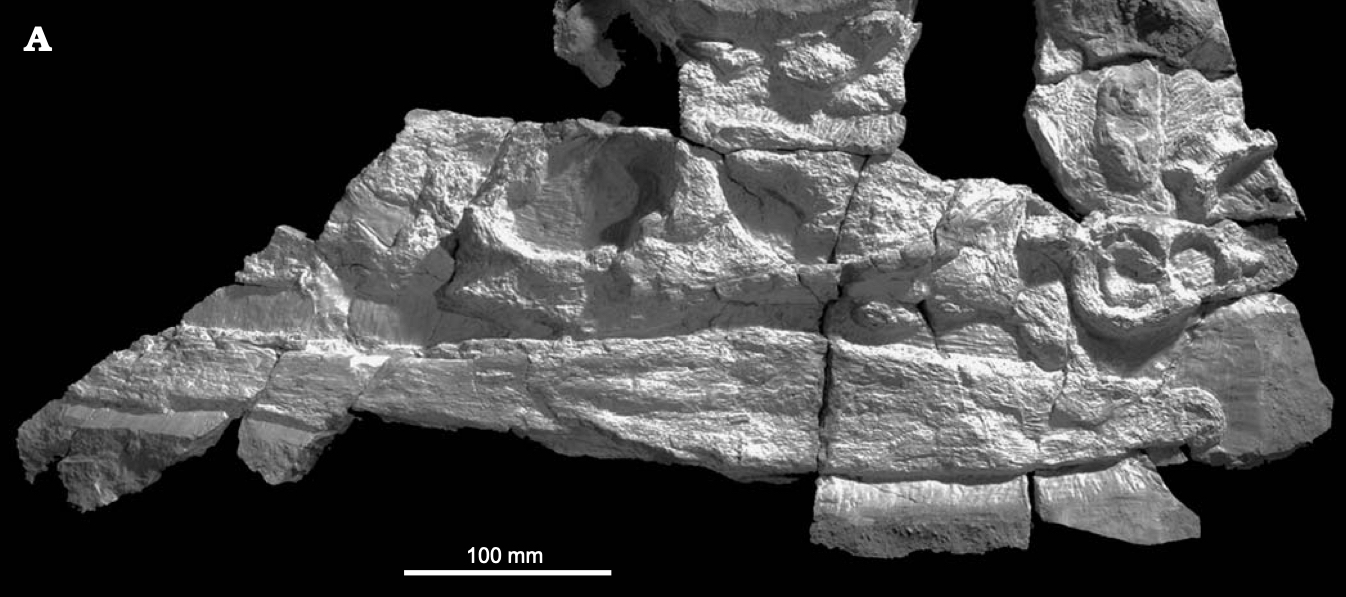
Anguanax is the first articulated plesiosaur ever found in Italy. It is a basal thalassophonean pliosaur from the Late Jurassic (middle Oxfordian). The type and only known specimen (MPPL 18797) of Anguanax was originally described as an indeterminate pliosaurid (Cau and Fanti 2014), but was subsequently named after reanalysis by the same authors the following […]
Cryonectes
Under construction

Gallardosaurus
Under construction

Kronosaurus
Due to its large size and ferocious appearance, Kronosaurus is one of the most famous plesiosaurs. The iconic skeleton referred to Kronosaurus on display in the Museum of Comparative Zoology in Harvard is nicknamed ‘plasterosaurus’ because so much of it is reconstructed in plaster. About a third of the skeleton is plaster and there are […]
Marmornectes
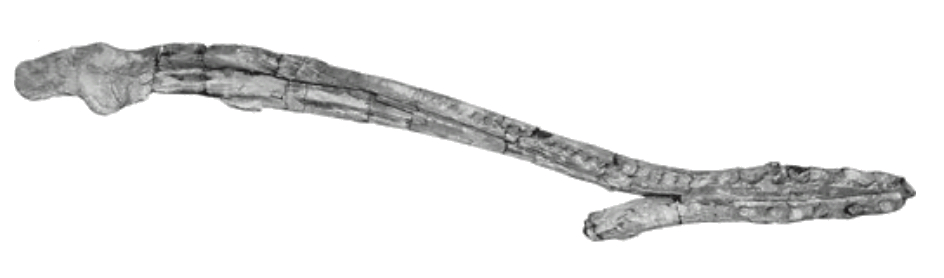
Marmornectes is a pliosaur with a long and narrow snout from the Oxford Clay. It was described and named by Ketchum and Benson (2011a). The type and only specimen (BEDFM 1999.201) comprises a substantially complete skeleton including a partial skull. Marmornectes is similar to Peloneustes but possesses some basal characters that were lost in Peloneustes […]
Megalneusaurus
Under construction

Monquirasaurus
Monquirasaurus is a giant pliosaurid from Colombia, South America. Originally named by Hampe (1992) as a species of Kronosaurus (K. boyacensis), the skeleton was later allocated to the new genus Monquirasaurus by Noè and Gómez-Pérez (2021). The genus name derives from ‘Monquira’, the administrative division in which the holotype was discovered.
Peloneustes
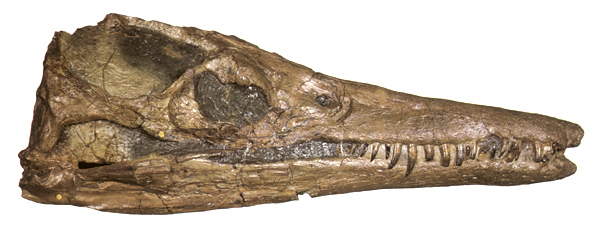
Peloneustes is one of several pliosaur genera from the Oxford Clay Formation in the UK. It is one of the better known pliosaurs from this horizon, represented by 12 nearly complete skulls and several skeletons. It is also the most abundant pliosaur from the Peterborough Member of the Oxford Clay Formation (Ketchum and Benson 2011b). […]


Simolestes
Simolestes has variously been allied with the Pliosauridae and the Rhomaleosauridae. The most noticeable difference between Simolestes and the other pliosaur taxa from the Oxford Clay (Liopleurodon, Peloneustes, Pachycostasaurus), is its much shorter snout and mandibular symphysis, a character is shares with the Rhomaleosauridae. However, this is probably a convergent character. Older descriptions of this […]
Stenorhynchosaurus
Under construction