Cryptoclidus

Genus:
Cryptoclidus
Author:
Seeley, 1892
Classification:
Age:
Late Jurassic
Location:
Peterborough, Cambridgeshire and Bedfordshire, UK; Normandy, France
Referred material (sp.):
To be compiled
Type species:

C. eurymerus

Species:
C. eurymerus
Author:
(Phillips, 1871)
Type specimen:
NHMUK 22656, complete skeleton.
Age:
Callovian, Late Jurassic
Horizon:
Oxford Clay Formation
Type location:
Peterborough, England
Referred material:
To be compiled

Species:
C. richardsoni
Author:
Lydekker, 1889
Type specimen:
To compile
Age:
To compile
Horizon:
To compile
Type location:
Dorset
Referred material:
To compile

Cryptoclidus, often wrongly spelled ‘Cryptocleidus’ after Andrews (1909), is a moderately sized plesiosaur with adults about four metres long (Brown 1981). It is known from a large number of individual specimens from the Oxford Clay Formation. Fossils of Cryptoclidus are relatively common, and provide a complete ontogenetic sequence from very young to old adult individuals. This makes Cryptoclidus one of the most studied and best understood of all plesiosaurs.

Referred specimen of Cryptoclidus in the Tubingen Museum, Germany.

The name Cryptoclidus was first introduced by Seeley (1892) as a “sub-genus of Muraenosaurus“. Seeley (1892) did not provide an explicit etymology for the name, but it comes from the Ancient Greek words κρυπτός (kryptos), meaning ‘hidden’, and κλεῖδες (kleîdes), meaning ‘clavicles’, because in ventral view much of each clavicle is overlapped and ‘hidden’ by the scapula.

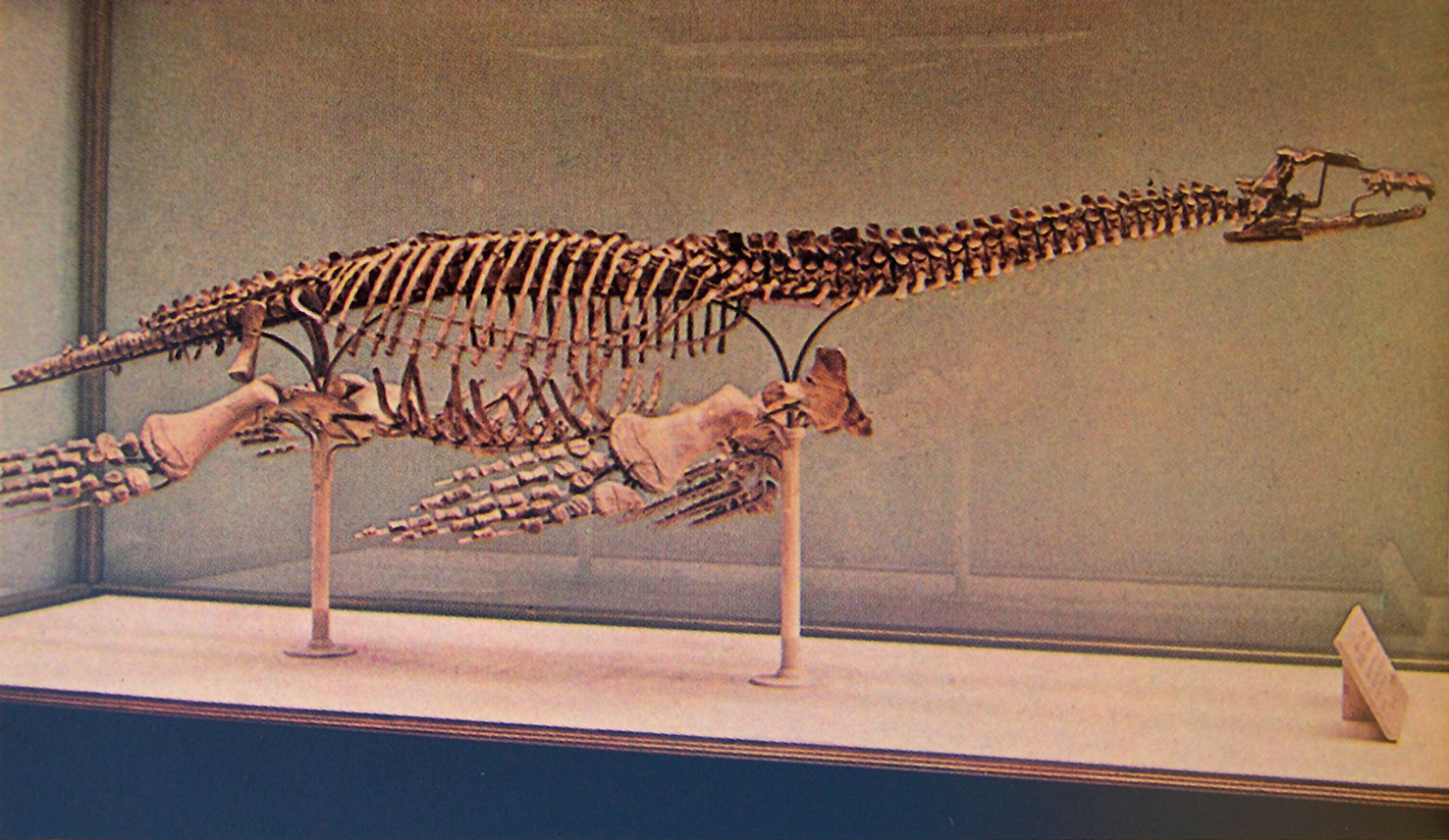
Full mounted skeletons of Cryptoclidus can be seen in several major museums including the Musee Palaeontologique, Paris; the Natural History Museum, London; the Hunterian Museum, Glasgow; and the American Museum of Natural History, New York.

Skull of Cryptoclidus in lateral view. From Brown (1981).

The genus has diagnostic teeth with reduced ornamentation. Each premaxilla contains six teeth, each maxilla 21 teeth, and each dentary 24-26 teeth. Cryptoclidus lacks suborbital fenestrae on its palate and has a large anterior interpterygoid vacuity. A small foramen is located along the postorbital-squamosal junction in C. eurymerus (Brown 1981).

Cryptoclidus used its numerous, tightly packed, small, sharp teeth, to catch squid and fish, or perhaps to sift silty sediments for benthic animals such as crustaceans.

Referred specimen of Cryptoclidus in the Tubingen Museum, Germany.

C. richardsoni differs from C. eurymerus only in the form of its humerus, which is more expanded distally (Brown 1981). The genus and species ‘Apractocleidus teretipes‘ was introduced by Smellie (1916) for a specimen now regarded as an old-adult of Cryptoclidus (Brown 1981).
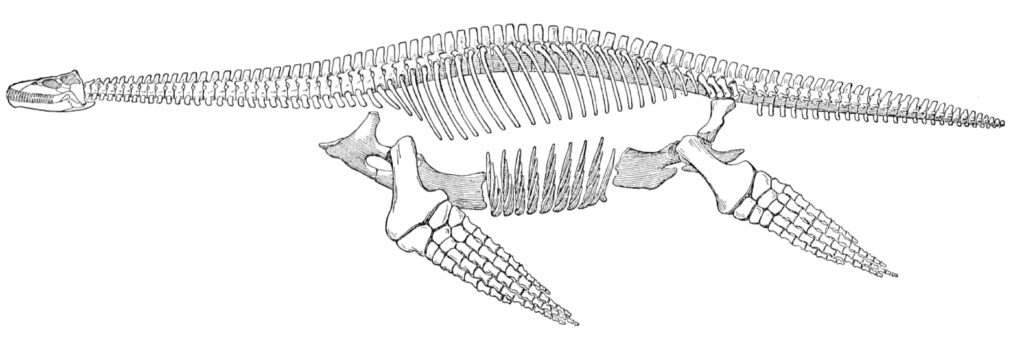
And old reconstruction of the skeleton of Cryptocidus from Andrews (1910)
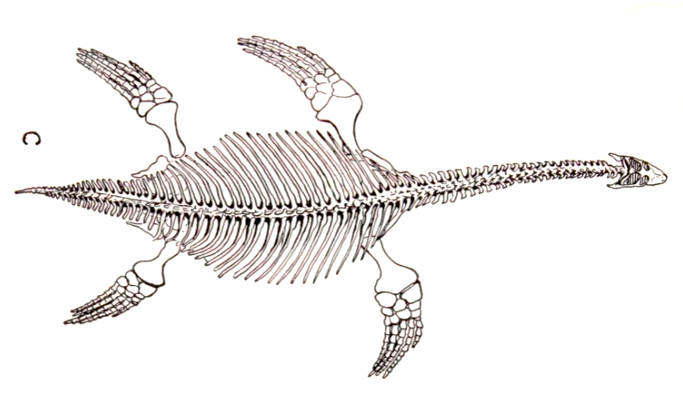
Reconstruction of the skeleton of Cryptoclidus is dorsal view from Gregory (1951)
Skeleton of Cryptoclidus in lateral view. From Brown (1981).
Cryptoclidus eurymerus. Postcard from the Paris Musee de Paleontologie
Adult Cryptoclidus, American Museum of Natural History, New York.
Adult Cryptoclidus, American Museum of Natural History, New York. Photo by Adam S. Smith
Adult individual of Cryptoclidus in the Natural History Museum, London.
Young individual of Cryptoclidus in the Natural History Museum, London.
Young individual of Cryptoclidus in the Natural History Museum, London. Photo by Adam S. Smith 2005.
Cryptoclidus (the type specimen of ‘Apractocleidus’, V.1091, with the tail of V.1104 and a replica head) in the Hunterian Museum, Glasgow, Scotland. Photo by Adam S. Smith. 2007.
Cryptoclidus excavation
3D ‘bust’ of a Cryptoclidus head in the York Museum, UK.
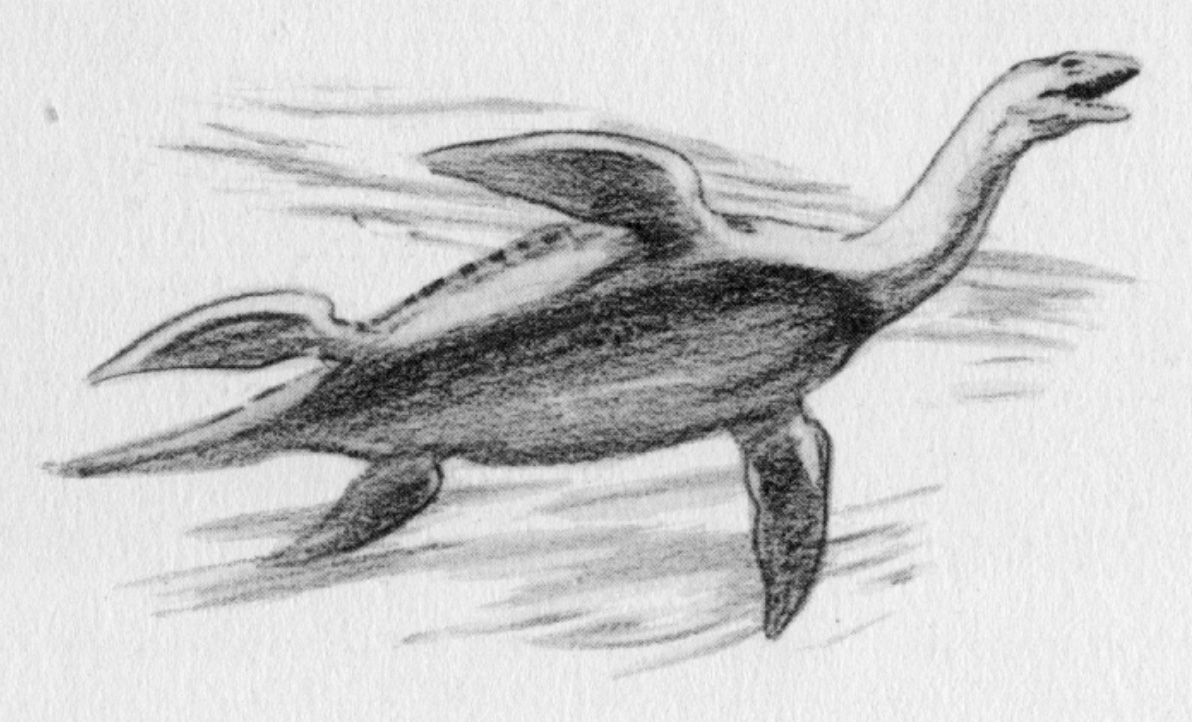
Cryptoclidus painting by Zdenek Burian.
Cryptoclidus illustration by Zdenek Burian.
Cryptoclidus on land, as depicted in ‘Walking with Dinosaurs’. From Martill and Naish 2000.